The National Society of Film Critics, a group of 60 of which I am a proud member, has just named Chloe Zhao’s The Rider as the best picture of 2018.
Alfonso Cuaron’s highly acclaimed Roma is runner-up (Cuaron also won Best Director and Best Cinematography).
Sony Picture Classics released The Rider on April 13, 2018, and boosted by good reviews, the indie Western earned $2,419, 031.

While making her first film, Songs My Brothers Taught Me, on the Pine Ridge Indian Reservation in 2013, Chloé Zhao got to know a group of Lakota cowboys. Despite their fair complexion, they were born and raised on the reservation and are Oglala Lakota Sioux and bonafide cowboys. They wear feathers in their hats to honor their Lakota ancestry, Indian cowboy, which may sound as an American contradiction. Fascinated with them, Chloe cast some of them as supporting actors in her film.
In 2015, while visiting a ranch on Pine Ridge Reservation, Chloé met the Lakota cowboy Brady Jandreau. Brady, then 21, is a member of the Lower Brule Sioux Tribe, currently resides on Pine Ridge.
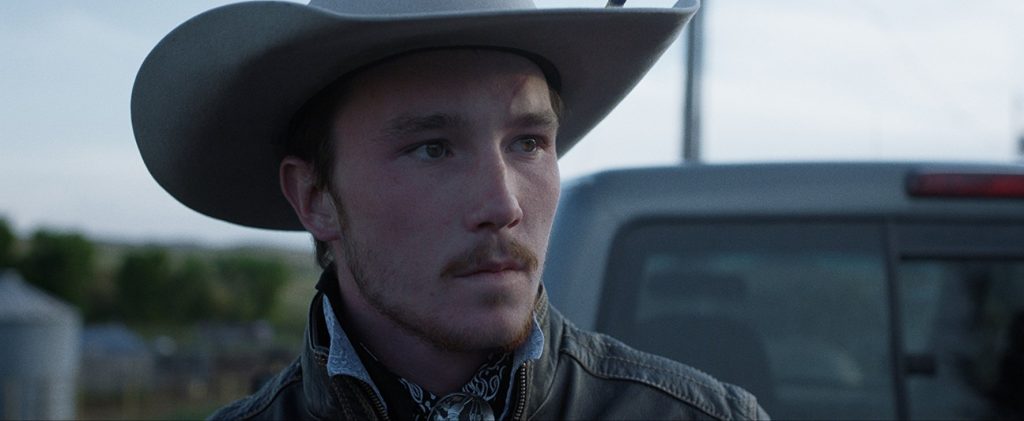
A saddle bronc rider and horse trainer, Brady hunts on horseback, fishes in the white river, spends most of his time working with wild horses, breaking and training them until they’re fit for selling.
He’s been doing it since he was eight years old. Brady understands every movement of the horse, like telepathic dance routine, one giving way to the other, until slowly and gently, a trust is formed.
Chloé was drawn to him and she started to gather ideas for a film about Brady. On April 1, 2016, Brady entered the PRCE rodeo in Fargo, North Dakota. He was to compete in the ‘Saddle Bronc’ section and felt confident after a string of successful rides during the season. But that night Brady was thrown off. The bucking horse stomped on his head and almost fatally crashed his skull. Brady’s brain bled internally. He had a seizure and fell into a three day coma.

Brady now has a metal plate in his head, and suffers from other health issues associated with the severe traumatic brain injury. The doctors advised him to never ride again. If he hits his head again, it could be fatal. But Brady was back breaking wild horses.
Chloé visited him and they talked about why he is risking his life. “Last month, we had to shoot Apollo (a horse Brady was training) because his leg got cut badly by barbed wire.” Brady told Chloé. “If an animal around here gets hurt like I did, they’ll get put down. I was only kept alive because I’m human and that’s not enough. I’m useless if I can’t do what I was born to do.”
Brady’s response made Chloé think about the psychological impact these injuries have on young men like him, what it must be like to live in the heartland of America, unable to match up to the ideal image of a cowboy, an image these young men have tried to live up to their whole lives.
Chloé decided to make a film about Brady’s struggles, both physically and emotionally, as he comes to terms with his injury.
Casting
As Chloé listened to Brady reflecting on the first months of his life after the injury, she cast Brady, his family and friends to play the fictionalized versions of themselves. Everyone in the film came from in and around the reservation. This includes Brady’s father, Tim, an old school cowboy who taught Brady all he knows. His bright and spirited sister, Lilly, who has Asperger’s Syndrome, and expressed herself completely free of inhibitions. His rodeo friends, all sharing in Brady’s hopes, fears and dreams, and one of his best-friends Lane, who is completely paralyzed after an accident that ended his promising bull riding career.
“Working with Brady and Lane in a scene was one of the most humbling and inspiring moments of my life.” Chloé reflects, “We started production on September 3, 2016. The five-week filming mainly took place on the reservation and in the surrounding Badlands. Brady, who works as a professional horse trainer, trained horses for the first half of each day in order to have them ready for a horse sale. So we were able to capture a lot of authentic footage of Brady training and interacting with horses, while fully taking advantage of the magical South Dakota sunset. We worked with a small crew, filming in people’s homes, real locations and events. This is my second collaboration with cinematographer Joshua James Richards. We strived to capture moments in an organic yet cinematic way in order to further integrate a complete sense of reality into the narrative. Through Brady’s journey, both on and off screen, I hope to explore our culture of masculinity and to offer a more nuanced version of the classic American cowboy. I also want to offer an authentic portrait of the rough, honest and beautiful American heartland that I deeply love and respect.”
The Story
Young cowboy Brady Blackburn (Brady Jandreau), once a rising star of the rodeo circuit and a gifted horse trainer, is warned that his riding days are over after a horse badly crushed his skull at a rodeo, putting him in a coma.
Back home on the Pine Ridge Indian Reservation, South Dakota, Brady struggles with the physical and emotional complications of the accident.
He is comforted by his little sister Lilly (Lilly Jandreau), who has Asperger’s Syndrome, but there are serious tensions between him and his gambling father, Wayne (Tim Jandreau), when Wayne resorts to selling Brady’s favorite horse to keep their trailer home.
With few alternatives for a different way of life, Brady feels a growing sense of inadequacy unable to ride and rodeo – the essentials of being a cowboy, and the defining elements in his life.
Frustrated, Brady starts to drift away from his rodeo friends and spend more time with his friend Lane (Lane Scott), who is in rehab after his once promising bull-riding career ended in a tragic accident.
Unable to stay away from his horses, he decides to start riding and training them again. However, the complications of his head injury soon puts him in dangerous situations and eventually back in the hospital. After another painful loss in his life, in an attempt to regain control of his own fate, Brady recklessly returns to the rodeo.
In conflict, Brady has to decide between healing with the help of his family and friends, or risking it all to keep his only true sense of self.