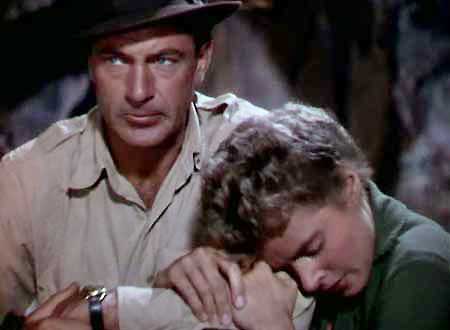
When the book was sold to Paramount, Hemingway stated that “Miss Bergman, and no one else should play the part.” He was impressed with her first American role, Intermezzo, though he hadn’t yet met her. When they did meet, he examined her at length and then said, “You are Maria!”
Cooper plays Robert Jordan, a courageous American teacher fighting with the guerrilla forces in the Spanish Civil War.
However, as soon as Jordan falls in love with Maria (Bergman), who had been raped by the Nationalist soldiers, the film changes its focus.
“It was a great picture, without political significance, said Paramount’s head Adolph Zukor. “We are not for or against anybody.” During the production, there were rumors (denied by Paramount) of political pressures and interference from representatives of Generalissimo Franco, who was sensitive about being called fascist, and by American officials who did not want to offend Spain.
In the end, politically speaking, it was another vague, middle-of-the-road film
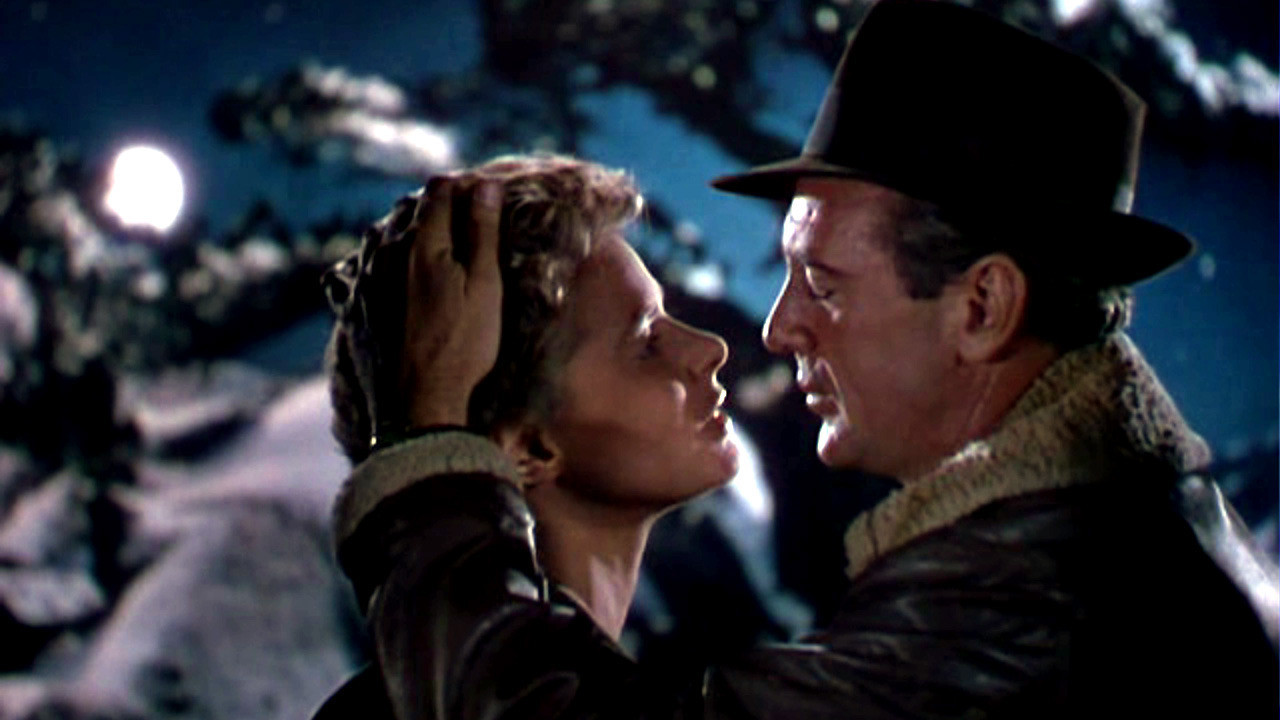
The film presents Hemingway’s notion of masculine adventurism, conveying Jordan’s single-minded commitment to the task of blowing up a strategic bridge in a mountain pass. Yet, artistically, “For Whom the Bell Tolls” is so diffuse, so tedious in pace, and replete with close-ups (of Cooper and Bergman’s tearful farewell), that all we remember of that picture is the romance and the stars.
My Oscar Book:
Oscar Nominations: 9
Picture, produced by Sam Wood
Actor: Gary Cooper
Actress: Ingrid Bergman
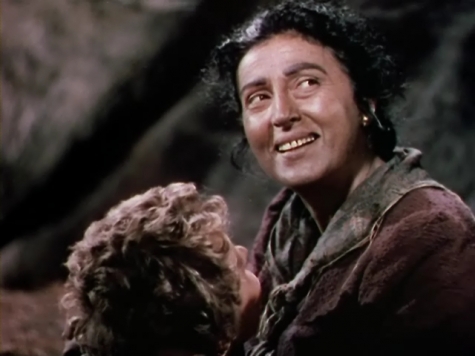
Supporting Actress: Katina Paxinou
Supporting Actor: Akim Tamiroff
Interior Decoration (color): Hans Dreier and Haldane Douglas
Cinematography (color): Ray Rennahan
Editing: Sherman Todd and John Link
Score: Victor Young
Oscar Awards: 1
Supporting Actress: Katina Paxinou
Oscar Context
This was the last year, in which ten films were nominated for the Best Picture. Beginnung in 1944, the top category was standardized to include only five nominees (as in most categories).
In 1943, “For Whom the Bell Tolls” competed for the Best Picture with “Casablanca” (which won), “Heaven Can Wait,” “The Human Comedy,” “In Which We Serve,” “Madame Curie,” “The More the Merrier,” “The Ox-Bow Incident,” “The Song of Bernadette,” and “Watch on the Rhine.”
The most nominated films were “The Song of Bernadette” (10), followed by “For Whom the Bell Tolls” (9). Though at the top of his form, Bogart lost the Oscar to Paul Lukas for “Watch on the Rhine,” which won the Best Picture from the New York Film Critics Circle. Bogart’s co-star, Ingrid Bergman was nominated for Best Actress in Paramount’s “For Whom the Bell Tolls.”
Akim Tamiroff lost the Supporting Actor Oscar to Charles Coburn for “The More the Merrier.” “The Phantom of the Opera” won the Color Cinematography and Interior Decoration. George Amy won the Editing Oscar for the War film “Air Force,” and Alfred Newman won the Scoring award for “The Song of Bernadette.”
Oscar Trivia: 4 Acting Nminations
“For Whom the Bell Tolls” is one of the few films in Oscar’s history, which garnered nominations for its performers in all four acting categories: Actor, Actress, Supporting Actor, and Supporting Actress.