Amores Perros signals the stunning debut of Mexican director Alejandro Gonzalez Inarritu, who, working with screenwriter Guillermo Arriaga, has made an audacious, sprawling narrative that’s grounded in his indigenous culture.
Grade: A- (****1/2* out
| Amores perros | |
|---|---|

US release poster
|
|
The Mexican film, whose title translates (poorly) as “Life’s a Bitch,” has won festival awards around the world and probably would have claimed the Oscar for Best Foreign Language Film were it not for Ang Lee’s crowd-pleasing Crouching Tiger, Hidden Dragon.
Shaped as a trilogy, the yarn follows disparate individuals with dissimilar lives through a chain of events that converge in a bloody car crash. The first plot focuses on a black dog named Cofi, that lives with a dysfunctional family that includes the teenager Octavio (Gael Garcia Bernal, bound to become an international star); his brother Ramiro (Marco Perez), an abusive hoodlum whose business is robbery, and Ramiro’s long-suffering and pregnant wife, Susana (Vanessa Bauche).
Octavio, who’s in love with Susana, decides to save his sister-in-law from Ramiro’s abuse. When he learns that Cofi killed a prize-winning dog in a street fight, he finds a way to finance his and Susana’s evacuation, thus enters the seedy world of dog fighting. A real killer, Cofi garners prize money for Octavio, which brings resentment from Jarocho (Gustavo Sanchez Parra), a street punk who keeps losing dogs.
The second strand tracks Daniel (Alvaro Guerrero), a magazine editor who leaves his wife and daughters for Valeria (Goya Toledo), a famous actress-model, but their bliss turns to misery when Valeria’s beloved pooch Richie suffers an undignified death.
In the third, a disenchanted revolutionary El Chivo (Emilio Echevarria), still grieving the loss of his daughter Maru (Lourdes Echevarria), has become a street wanderer, who cares for street dogs and does dirty work for a corrupt cop.
Rich or poor, most of the characters in “Amores Perros” live in–or experience directly–extreme danger on a daily basis.
The film’s recurring motifs are dog fights, both orchestrated and more spontaneous ones. Inarritu and his collaborators plunge through the story with passion, emotion, and melodrama, and end result is a film that’s fresh, shocking, violent, and profane, serving a useful reminder of the potential power of moving images when used in an unconventional way.
Scribe-novelist Guillermo Arriaga has described “Amores Perros,” which took no less than 36 drafts, as “fiercely human.” And indeed, the movie’s fierceness includes gruesome dog fighting, sudden bursts of violence, and intensely melodramatic suffering.
The movie’s text is a triptych whose overlapping structure recalls Tarantino’s “Pulp Fiction,” and would become a staple of Inarritu’s work (Babel in 2007).
The filmmakers develop well the notion of disparate characters, who are linked by bizarre forces of fate and circumstance, and going through anguish and suffering in a grand, quasi-biblical way.
As noted, the main intersection that brings these people together is a road accident, to which the movie comes back time and again.
“Amores Perros” feels overwrought–but by design. All the characters navigate their lives intensely, hoping to succeed against all odds, but as one of them observes poignantly, “If you want to make God laugh, tell him your plans.”
Seen as a morality tale, the film suggests that those who live by violence, adultery and vanity will be judged for their sins and ultimately will be undone themselves by the same vices.
Easily the nost talked about movie at the 2000 Cannes Film Fest (though it was not in the Main Competition), Amores Perros became a huge critical and commercial hit, earning $21 million against an ultra-small budget of about $2 million.
My Oscar Book:
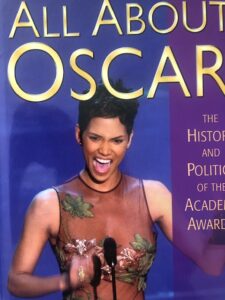
Oscar Context
Representing Mexico, the movie was nominated for (but did not win) the Best Foreign Language Oscar Award.
Credits:
Directed, produced by Alejandro González Iñárritu
Written by Guillermo Arriaga, story by Iñárritu and Guillermo Arriaga
Music by Gustavo Santaolalla
Cinematography Rodrigo Prieto
Edited by Iñárritu, Luis Carballar, Fernando Pérez Unda
Production companies: Zeta Entertainment, Alta Vista Films
Distributed by Nu Vision
Release date: May 14, 2000 (Cannes)
Running time: 153 minutes
Budget $2.4 million
Box office $20.9 million