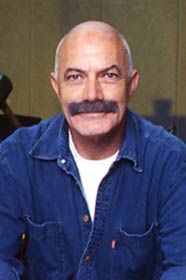
One of the most influential horror filmmakers of all time, Tobe Hooper was born in Austin.
Hooper’s feature film debut was the indie Eggshells (1969), which he co-wrote with Kim Henkel.
The two reunited to co-write The Texas Chain Saw Massacre (1974), which Hooper also directed. The film went on to become a classic of the genre, and one of the most influential films ever made.
Hooper subsequently directed the horror film Eaten Alive (1976), followed by the 1979 miniseries Salem’s Lot, an adaptation of Stephen King’s novel.
Hooper then direct The Funhouse (1981), a studio slasher film distributed by Universal Pictures.
The following year, he directed the supernatural horror Poltergeist, produced by Spielberg.
In the mid-1980s, Hooper directed two science fiction horror films: Lifeforce (1985) and Invaders from Mars (1986), followed by The Texas Chainsaw Massacre 2 (1986), a big-budget sequel to his original film. The film explores hicksploitation themes related to his childhood.
The 1990s saw Hooper directing various horror and sci-fi projects, including Spontaneous Combustion (1990), which he also co-wrote; the television anthology film Body Bags (1993); and The Mangler (1995), another adaptation of a Stephen King story.
Hooper directed several projects throughout the 2000s, including the monster film Crocodile (2000), an episode of the sci-fi miniseries Taken (2002), and two episodes of Masters of Horror (2005–2006).
Hooper was born January 25, 1943, in Austin, Texas, to Lois Belle (née Crosby) and Norman William Ray Hooper, who owned a theater in San Angelo.
He first became interested in filmmaking when he used his father’s 8 mm camera at the age of nine. He went to college at the University of Texas, Austin. He was present at the college on August 1, 1966, when Charles Whitman opened fire random from the University’s clock tower, fatally shooting a police officer that was close by Hooper.
Hooper spent the 1960s as a college professo and documentary cameraman. His 1965 short film The Heisters was invited to be entered in the short subject category for an Academy Award, but was not finished in time for the competition that year.
His first feature film, Eggshells (1969), was made for $40,000.
Hooper leapt to fame with The Texas Chain Saw Massacre, which combined elements from a story he wrote about isolation and darkness, inspiration of graphic news coverage of violence, and his belief that people were the true monsters.
Along with Kim Henkel, they co-wrote a screenplay with elements from the murders of Ed Gein and Elmer Wayne Henley. They formed a company, Vortex, which produced the film alongside Jay Parsley and Richard Saenz.
The low budget (about $140,000) meant that the film was shot 7 days a week, having shooting times up to 16 hours a day, dealing with hot temperatures, high humidity and limited special effects.
Hooper had to deal with the MPAA about the rating; he hoped the limited gore in the film would give it a PG, but the original print was given X rating. After some cuts, it was given an R rating.
The film was cited as one of the scariest films of all time.
It was also a huge commercial success, making $30 million in the US, while being one of the highest grossing indie films of the 1970s.
Hooper’s next film was Eaten Alive (1976), co-written by Henkel and producers Alvin L. Fast and Mardi Rustam. The film was inspired by serial killings–the murderer Joe Ball, who killed at least two people in the 1930s and whose crimes led to his nicknames of ‘The Alligator Man’ and ‘The Butcher of Elmendorf’.
The movie was filmed on sound-stages in California, and Hooper provided the music alongside Wayne Bell, but he walked off the production before shooting completed.
Hooper had his biggest budget yet with the TV mini-series of Salem’s Lot (1979), shot on budget of $4 million for CBS while released theatrically in some countries. It was a screening of Massacre that led producer Richard Kobritz to hire Hooper as director. He shot the film from July to August 1979, although the film differed from the source material (in the violence and graphic scenes) in order to meet broadcast standards.
He described it as ‘very spooky – it suggests things and always has the overtone of the grave. It affects you differently than my other horror films. It’s more soft-shelled…it has atmosphere which creates something you cannot escape – the reminder that our time is limited and all the accoutrements that go with it, such as the visuals.’
Hooper then madew The Funhouse (1981) about teenagers stalked by a killer in a carnival funhouse.
In 1982, Hooper made Poltergeist, based on a story by Spielberg, who selected him based on his prior work, It was Hooper who collaborated with Spielberg to make it more of a ghost story than the original sci-fi-treatment had been; it had originally been conceived as sequel to Close Encounters of the Third Kind.
Cannon Films approached Hooper with the offer of a three-picture deal. He made Lifeforce (1985), Invaders from Mars (1986) and The Texas Chainsaw Massacre 2 (1986).
Hooper also began working steadily in television.
Hooper’s later works included Spontaneous Combustion (1990); the television movie I’m Dangerous Tonight (1990); and Night Terrors (1993). He directed an installment of the made-for-television feature Body Bags (1993). His works also include The Mangler (1995), The Apartment Complex (1999), Crocodile (2000), Toolbox Murders (2004), and Mortuary (2005).
Hooper was asked to contribute to the series Masters of Horror; he directed “Dance of the Dead” (2005) with Robert Englund in the first season, and “The Damned Thing” in the second season.
In 2010, writer and actor Mark Gatiss interviewed Hooper for the third episode of his BBC documentary series A History of Horror.
Hooper’s first novel, Midnight Movie, was published on Three Rivers Press in 2011.
His supernatural thriller film Djinn premiered at the 2013 Abu Dhabi Film Festival.
Hooper was married three times. He married his first wife, Maev Margaret Noonan, in 1961. They divorced in 1969, producing one son, William Tony Hooper, who was born in 1966. In the Fall of 1979 Hooper declared “I’m divorced. I was married very young and been divorced about eight years.” At the time of the interview, his son was 13 and lived with him in Los Angeles.
Hooper married again in 1983 to Carin Berger (daughter of actor William Berger), but they divorced in 1990. He later married Rita Marie Bartlett in 2008, but they divorced in 2010.
Hooper died of natural causes in Sherman Oaks neighborhood of Los Angeles on August 26, 2017, at age 74.
Filmmakers influenced by Hooper include Hideo Nakata, Wes Craven, Rob Zombie, Alexandre Aja, Jack Thomas Smith, Kiyoshi Kurosawa, and Nicolas Winding Refn.
Ridley Scott said that his work on Alien was influenced more by Hooper’s The Texas Chain Saw Massacre than any other genre film.
Filmography (1969-2013): 44 years, 15 features
1969 Eggshells, also editor and cinematographer
1970 Peter Paul and Mary: The Song Is Love, Documentary film, also editor and cinematographer
1974 The Texas Chain Saw Massacre, also producer
1976 Eaten Alive
1981 The Funhouse
1982 Poltergeist
1985 Lifeforce
1986 Invaders from Mars
The Texas Chainsaw Massacre 2
1990 Spontaneous Combustion
1993 Night Terrors
1995 The Mangler
2000 Crocodile
2004 Toolbox Murders
2005 Mortuary
2013 Djinn
Producer
The Texas Chainsaw Massacre (2003), co-producer
The Texas Chainsaw Massacre: The Beginning (2006)
Executive producer
Texas Chainsaw 3D (2013)
Leatherface (2017)