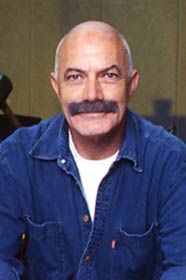
Charles Burnett is a pioneering, if vastly underestimated, African American film director, producer, writer, editor, actor, and cinematographer.
His most popular films include Killer of Sheep (1978), My Brother’s Wedding (1983), To Sleep with Anger (1990), The Glass Shield (1994), and Namibia: The Struggle for Liberation (2007).
He has also made shorts, documentaries, and a TV series.
Called “one of America’s very best filmmakers” and “the nation’s least-known great filmmaker and most gifted black director,” Burnett has enjoyed a long, diverse, but also interrupted career.
Burnett was born on April 13, 1944, in Vicksburg, Mississippi, to nurse’s aide and military father; he is a descendant of people from Sierra Leone.
In 1947, Charles’s family moved to Watts, a black neighborhood in South Los Angeles. Burnett was interested in art from a young age, but the economic pressure to maintain a stable job kept him from pursuing film in college.
Watts had a significant effect on Burnett’s life and work. The community gained notoriety in 1965 when violent riots caused the deaths of 34 people and injured more than 1,000. Watts again made the news in 1992 when protestors turned to looting and arson after the acquittal of police officers tried for the beating of Rodney King.
The neighborhood had a strong influence on Burnett due to the large number of Southerners living in the area. His movies often revolve around southern folklore, mixed with modern themes. His acknowledged masterpiece, Killer of Sheep, is set in Watts.
Burnett enrolled at Los Angeles City College to study electronics for a career as electrician. Dissatisfied, he took a writing class and decided to further explore his earlier artistic ambitions. He earned a BA in writing and languages at the University of California, Los Angeles (UCLA).
In interview for Cahiers du Cinéma, Burnett speculated that “a serious speech impediment” may have led him to become a filmmaker: “I always felt like an outside–an observer–who wasn’t able to participate because I couldn’t speak very well. So this inability to communicate must have led me…to find some other means to express myself…I really liked a lot of the kids I grew up with. I felt an obligation to write something about them, to explain what went wrong with them. I think that’s the reason I started to make these movies.”
Burnett continued his education at the UCLA film school, earning Master of Fine Arts degree in theater arts and film. His experiences at UCLA had profound influence on his work, and the students and faculty he worked with became mentors and friends. Some fellow students included Larry Clark, Julie Dash, Haile Gerima, Billy Woodberry.
The students were involved in each other’s films. Burnett worked as a cinematographer for Haile Gerima’s 1979 movie Bush Mama, as a crew member for Julie Dash’s 1982 Illusions, and as a writer and cameraman for Billy Woodberry’s Bless Their Little Hearts.
His professors Elyseo Taylor, who created the department of Ethno-Communications, and Basil Wright, a British documentarian, also had influence on his work.
The turbulent events of 1967-1968 were vital in establishing the UCLA filmmaking movement known as the “Black Independent Movement,” in which Burnett participated.
The films of these African and African American filmmakers had strong relevance to the politics and culture of the 1960s, yet stayed true to the history of their people. Their characters shifted from the middle class to the working class to highlight the tension caused by class conflict within African American families.
The independent writers and directors strayed away from the mainstream and won critical approval for remaining faithful to African American history.
Another accomplishment of the Black Independent Movement and Burnett was the creation of the Third World Film Club. The club campaigned to break the American boycott banning all forms of cultural exchange with Cuba. Many critics have compared the films of the Black Independent Movement to Italian neorealist films of the 1940s, Third World Cinema films of the 1960s and 1970s, and the 1990s Iranian New Wave. At the time the movement flourished, many countries in the Third World were involved in a struggle for revolution, inspiring them to create films expressing their own indigenous history and culture.
Many Black Independent Movement films have been considered a response to Hollywood and Blaxploitation films (Shaft) that were popular at the time.
Burnett’s earliest works include his UCLA student films made with mates, Several Friends (1969) and The Horse (1973), in which he was the director, producer, and editor.
Burnett’s first feature film, Killer of Sheep, was his UCLA master’s thesis. It took Burnett five years to finish, partly due to the imprisonment of one of the film’s actors, and was released to the public in 1978. The cast consisted mainly of his friends and film colleagues and it was shot primarily with a handheld camera, seemingly in documentary style.
The main character was played by Henry G. Sanders, a Vietnam vet who had studied cinema at Los Angeles City College and was enrolled in several classes at UCLA. Sanders went on to a career in films and TV, including roles in Rocky Balboa, ER, Miami Vice, and The West Wing.[8] The lead female character in Killer of Sheep was played by Kaycee Moore, who went on to act in former UCLA classmate Julie Dash’s film Daughters of the Dust.
The story follows the protagonist Stan, a slaughterhouse worker, who struggles to make enough money to support his family. The movie “offers no solutions; it merely presents life.” Killer of Sheep revolves around rituals, in the family, childhood, oppression, and resistance to oppression.
The soundtrack of ballads, jazz, and blues includes artists Faye Adams, Dinah Washington, Gershwin, Rachmaninov, Paul Robeson, and Earth Wind & Fire.
The film was only screened occasionally because of its poor 16mm print quality, failing to find widespread distribution due to the cost and complexity of securing music rights. It was restored by the UCLA Film & Television archive in new 35mm print of much higher quality.
The re-released film won many awards including the critics’ award at the Berlin Film Fest, first place at the Sundance Film Fest in the 1980s, then called the USA Film Festival, and a Special Critics’ Award from the 2007 New York Film Critics Circle. It was an inductee of the 1990 National Film Registry list.
Killer of Sheep was chosen as one of the 100 Essential Films of All Time by the National Society of Film Critics (NSFC) in 2002. Burnett was awarded a Guggenheim Foundation Fellowship in 1981, after the film’s completion.
In 1983, Burnett served as the director, producer, director of photography, and writer for My Brother’s Wedding. My Brother’s Wedding was his second full-length film, but was not released because of a mixed review in The New York Times after playing at the New Directors/New Films Festival in 1983. As in Killer of Sheep, the actors were amateurs, including the costume designer’s wife. The role of Pierce Mundy, the protagonist, was played by Everett Silas. Mundy struggles to choose between his brother’s middle-class existence and his best friend’s working-class world.
The movie was the first feature Burnett shot on 35mm color film, on a budget of about $80,000. The movie was acquired by Milestone Films, restored by the Pacific Film Archive at the University of California, Berkeley, and digitally reedited by Burnett.
To Sleep with Anger was Burnett’s first higher-budget film, about $1.4 million. The grant rom the John D. and Catherine T. MacArthur Foundation helped Burnett support his family while working on the film. The $250,000 grant spread over the course of five years is awarded to gifted individuals to pursue personal projects.
The movie was set in South Central LA and followed the same themes of family and southern folklore as most of his films. The story concerns a lower middle class Los Angeles family that welcomes a guest from the South who overstays his welcome and causes a major disturbance in the family. The family’s instability seems to reflect the larger community’s volatility. To Sleep with Anger was Burnett’s first film to rely on professional actors like Danny Glover, Paul Butler, Mary Alice, Carl Lumbly, and Vonetta McGee.
Glover, who plays Harry Mention, reduced his fee and also invested in the production. A box-office favorite known for the Lethal Weapon films, Glover continued to star in many successful productions. Although acclaimed by critics, To Sleep with Anger did poorly at the box office, which Burnett attributed to poor marketing and distribution and lack of good taste.
The film won many awards, including best screenplay from the National Society of Film Critics (NSFC), the first award of its kind given to African American writer).
Other awards included two Independent Spirit Awards for Best Director and Best Screenplay, the American Film Institute’s Maya Deren Award, the Special Jury Recognition Award at the 1990 Sundance Film Fest, Special Award from the Los Angeles Film Critics Association (LAFCA), and nominations for Burnett and Glover by the New York Film Critics Circle (NYFCC).
The Glass Shield follows a story of corruption and racism in the Los Angeles County Sheriff’s Department. It was Burnett’s first film aiming to reach catering wider audiences, featuring rapper Ice Cube, as a man wrongfully convicted of murder. The protagonist, JJ Johnson, is played by Michael Boatman.
The movie’s themes include the powerlessness of its African American and female characters. Johnson’s fellow Sheriff’s Deputy, the first woman at the station, is forced to deal with sexism both within the Sheriff’s department and on the streets. The Deputy is played by Lori Petty, who went on to become a director in the 2008 movie The Poker House.
The Glass Shield was nominated for Golden Leopard at the 1994 Locarno Fest, and later became Burnett’s most commercially successful film, earning $3 million in the U.S.
Namibia: The Struggle for Liberation follows the story of Namibia’s hardships while attempting to win independence from South African rule. The film is based loosely on the memoirs of Namibia’s first president, Sam Nujoma, the former leader of the South West Africa People’s Organization SWAPO. The script was based on Nujoma’s autobiography, Where Others Wavered, and was a government-commissioned celebration of liberation. Both main actors, Carl Lumbly and Danny Glover, participated in Burnett’s prior film To Sleep with Anger.
The movie was shot in Namibia and casting was difficult because the over 200 speaking parts were mostly given to local Namibians, many of whom had differing dialects. The film was served as opening-night of the 2008 New York African Film Fest.
Burnett’s documentaries include America Becoming (1991), Dr. Endesha Ida Mae Holland (1998), Nat Turner: A Troublesome Property (2003), For Reel? (2003), and Warming by the Devil’s Fire (2003) which was part of a TV series called The Blues. America Becoming was a made-for-television documentary financed by the Ford Foundation. The documentary concentrated on ethnic diversity in America, especially the relations between recent immigrants and other racial groups. Dr. Endesha Ida Mae Holland was a short documentary about a civil rights activist, playwright, and professor who fought hard to overcome obstacles caused by racism and injustice. Nat Turner: A Troublesome Property featured Burnett’s actor and friend Carl Lumbly.
The movie won a Cinematography Award in 2003 from the Long Beach Film Fest. Warming by the Devil’s Fire was an episode Scorsese’s six-part compilation PBS documentary. Burnett worked as a producer for the documentary For Reel?
Burnett was involved in shorts, such as Several Friends (1969), The Horse (1973), When It Rains (1995), Olivia’s Story (2000), and Quiet as Kept (2007).
“When It Rains” follows the story about a musician that tries to assist his friend with paying her rent. Quiet as Kept is a story about a relocated family after Hurricane Katrina.
Television films
Burnett has directed many made-for-TV movies, including Nightjohn (1996), Oprah Winfrey Presents: The Wedding (1998), Selma, Lord, Selma (1999), Finding Buck McHenry (2000), and Relative Stranger (2009).
Nightjohn was adapted from a Gary Paulsen novel, and premiered on the Disney Channel in 1996 to high praise. The story follows an escaped slave who learns to read and returns to his former home to teach others to read and write. Nightjohn was awarded the Vision Award of the NAMIC Vision Awards in 1997 and a Special Citation Award from the National Society of Film Critics (NSFC) in 1998, and was nominated for Young Artists Awards in 1997.
The Wedding was directed by Burnett, with Oprah Winfrey as executive producer. Halle Berry and Carl Lumbly star in a drama about the wedding of a wealthy African American woman and a poor white musician.
Selma, Lord, Selma, a Disney movie, follows the story of a young girl inspired by Martin Luther King Jr. who decides to join the historic protest march from Selma to Montgomery. Selma, Lord, Selma was nominated for a Humanitas Prize in 1999 and an Image Award from Image Awards in 2000. Finding Buck McHenry is about a young boy who tries to discover whether his baseball coach is a former legend in baseball. Finding Buck McHenry won a Daytime Emmy in 2001, a Silver Award from WorldFest Houston in 2000, and a Young Artists Award in 2001, and was nominated for an Image Award in 2001.
Relative Stranger was nominated for an Emmy in 2009, an Image Award in 2010, and Vision Award from NAMIC Vision Awards in 2010.
In 1988 Burnett won a MacArthur Fellowship (“Genius Award”) for his work as an independent filmmaker.
Burnett earned the Freedom in Film Award from the First Amendment Center and the Nashville Independent Film Fest. The award honored his commitment to presenting cultural and historical content that he felt needed to be discussed, rather than focusing on commercial success.
Burnett was honored by the Film Society of Lincoln Center and the Human Rights Watch International Film Fest in 1997.
Burnett has received grants from the Rockefeller Foundation, the National Endowment for the Arts, and the J.P. Getty Foundation. The Howard University’s Paul Robeson Award was given to Burnett for achievement in cinema.
To honor his achievements, the mayor of Seattle declared February 20, 1997, Charles Burnett Day.
In September 2017 it was announced that Burnett was to receive a Governors Award – known as an “honorary Oscar” – from the Academy of Motion Picture Arts and Sciences (AMPAS).
The recurring theme in Burnett’s work: history’s effects on the structure of family of working-class African-Americans, depicting them without stereotypes and clichés.
Another recurring theme was struggle and in liberation, influenced by the UCLA’s Third World Film Club, which championed various revolutions in the 1960s and 1970s.
In 1999, Burnett directed a film called The Annihilation of Fish, an interracial romance film starring James Earl Jones and Lynn Redgrave.
The film won the Jury Award from the Newport Beach Film Fest in 2001, the Audience Award at the Sarasota Film Fest in 2001, and Silver Award at WorldFest Houston in 2000.
Burnett and two other directors, Barbara Martinez Jitner and Gregory Nava, directed the TV series “American Family.”
“American Family” was nominated for 2 Emmys and won many other awards.
He is currently in pre-production on two films projects: The Emir Abd El-Kadir and 83 Days: The Murder of George Stinney.
In 2019, it was announced that Burnett would direct the film Steal Away, based on Robert Smalls’s escape from slavery.
Burnett is married to actress and costume designer Gaye Shannon-Burnett. They have two sons, Steven and Jonathan.
Filmography
Several Friends (short, 1969)
The Horse (short, 1973)
Killer of Sheep (1978)
My Brother’s Wedding (1983)
Bless Their Little Hearts (1984)
To Sleep with Anger (1990)
America Becoming (TV documentary, 1991)
The Glass Shield (1994)
When It Rains (short, 1995)
Nightjohn (TV film, 1996)
The Final Insult (docufiction short, 1997)
The Wedding (TV, 1998)
Dr. Endesha Ida Mae Holland (docu short, 1998)
Selma, Lord, Selma (TV film, 1999)
The Annihilation of Fish (1999)
Olivia’s Story (short, 2000)
Finding Buck McHenry (TV film, 2000)
American Family (TV series, 2002)
Nat Turner: A Troublesome Property (TV documentary, 2003)
For Reel? (TV, 2003)
The Blues: Warming by the Devil’s Fire (TV documentary, 2003)
Namibia: The Struggle for Liberation (2007)
Quiet as Kept (short, 2007)
Relative Stranger (TV film, 2009)
Power to Heal: Medicare and the Civil Rights Revolution (with Daniel Loewenthal, TV documentary, 2018)