Parton Was Staunch LGBT Ally, Even When the Chips Were Down
Across her decades-long career, Parton always made sure everyone knew that humanity included the LGBTQ+ community.

For the LGBTQ+ community, losing Parton goes beyond mourning a gay icon. This is a woman whose outspoken advocacy made us feel seen and valued within the conservative world of country music.
Dolly bridged the gap between the often-hostile homes we’d left behind and the worlds we’d created for ourselves. She was the person who showed us how to exist in both places at once, and now that she’s gone, there’s concern about who could even begin to span that divid


When news of Dolly’s passing hit Tuesday, Aug 25, social media was filled with tributes from celebs and world figures, but the two that stood out were the effusive post from Donald Trump calling for lowering of the flags.
Then a heartfelt and eloquence remembrance of from Hillary Clinton, who called Dolly: “the best of America who did all the good she could, for all the people she could, for as long as ever she could.”
No one else could get those two to agree on anything, but that’s the power of Dolly.
Throughout her career, Dolly used her platform to help us see past our differences to the humanity that unites us all, and she always made sure everyone knew that humanity included the LGBTQ+ community. It was inspiring, and sometimes puzzling, to watch her pull it off, too.
This is the same woman who recently released an album, Rockstar, featuring a collaboration with anti-LGBTQ+ poster boy Kid Rock next to duets with queer icons Melissa Etheridge, Brandi Carlile and Elton John. And both sides seemed to accept it, because it was Dolly. Even in the midst of that album launch, Dolly spoke of being called to love and accept Kid Rock just as she did her queer fans.
In a tribute to Dolly on Instagram, “before I met her, I loved her because she took a risk and accepted me (and all of us) for being gay in a time where she didn’t need to say anything. And she has been asked to comment and speak on MANY things over the years … choosing only to speak on that which brings love and mercy to real people, and shutting down any line of questioning that won’t. She never wavered on accepting anyone for who they were, and who they were meant to be.”
Dolly spoke up for queer folks at a time when it could have cost her large chunk of her country music audience.
She was already a superstar in the mid-1980s, just as the AIDS crisis was coming into focus and conservative Christian groups were ramping up their anti-LGBTQ+ attacks in the Reagan-era culture wars. But Dolly disregarded the possible consequences.
“I got a huge gay following and some really macho-looking women,” Parton told Andy Warhol in 1984. “To me, people are people. Many of my friends are gay, male and female. I don’t judge people. I don’t care what people do in their bedrooms and people shouldn’t care what I do in mine.”
Dolly and the queer community just got each other. We recognized in each other a longing for self-realization, as Dolly sang about in so many songs, such as “Light of a Clear Blue Morning” or my personal favorite, “Wildflowers.” For many of us LGBTQ+ folks, becoming ourselves meant moving away from our hometowns to find acceptance in a big city nearby or perhaps a different region of the country. As a southern woman bucking at the limitations of the male-dominated country music industry in the mid-1970s, Dolly Parton felt those same strictures around her and longed for creative freedom.
As she told me later, her rise to superstardom wasn’t built on blind ambition. It was a spiritual quest to fulfill her destiny.
“I read something Mother Theresa said once: ‘When I stand before God, I want to be able to say, “God, I used everything you gave me.”’ And so that was kinda my attitude,” she said. “I feel God gave me my talent, and I didn’t think he meant for me to be restricted. I wanted to be all I can be. I want to know what’s out there. And if I do good at it, I’ll maybe help some other people.”
Dolly never forgot her goal of helping others.
In 1986, Dolly and Sandy formed Sandollar, production company that produced Buffy the Vampire Slayer as well as Dolly’s own TV and film projects.
But their first major project under Sandollar banner made a bold statement about Dolly’s LGBTQ+ advocacy: 1989’s Common Thread: Stories From the Quilt told the story of the AIDS Memorial Quilt and won the best documentary Oscar feature the next year.
My Book:

Gay Directors, Gay Films? By Emanuel Levy (Columbia University Press, August 2015).
In 2005, Dolly wrote and recorded “Travelin’ Thru” as inspirational theme song for the film Transamerica, starring Felicity Huffman as a transgender woman.
My Oscar Book:
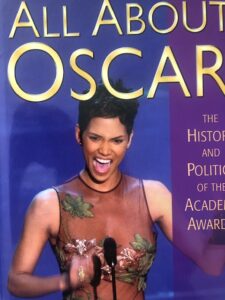
The song was nominated for best original songOscar, and Dolly performed it on 78th Oscars telecast, leading Jack Nicholson, Meryl Streep and 9 to 5 co-star Lily Tomlin clapping along as she sang of the enveloping love of God for everyone, especially trans people.
“I just asked God to kinda, you know, work it through me,” she said. “And I just felt like it would have to be horrible to be trapped in your own body, to be one person and have to live another way. I just think we should all be free and should all be loved and accepted. And so that song came to me very much on wings of spirit.”
We know now that Dolly’s advocacy for the transgender community started within her own organization. Dolly’s book editor, Elissa Altman, revealed on Tuesday that Dolly actually paid the medical costs for a member of her staff to transition back in the 1990s.
For so many of us queer folks, Dolly showed us a way to still hold love for where we came from, even as we acknowledged the real hurt and harm being done. But most importantly, she showed us how to keep the lines of communication open while still insisting on this simple truth — that queer people are a beloved and beautiful part of God’s creation.
Dolly’s home state of Tennessee has led the nation in introducing and passing anti-LGBTQ+ legislation.
While most country artists stayed silent on the matter, Dolly once again spoke up about the situation facing her fellow Tennesseans, saying “I see how broken-hearted they get over certain things, and I know how real they are. They cannot help that any more than I can help being Dolly Parton. If there’s something to be judged, that is God’s business. But we are all God’s children and how we are is who we are.”