Gay Pride Month in Europe
Films about Gay Characters

By the time ‘Bringing Up Baby came out, the word ‘gay’ was known in some circles to mean homosexual,” TCM host Karger said. “The story goes that Grant ad libbed that line, knowing what he was saying when he allegedly came up with that line.”
Alonso Duralde agrees: “When I wrote about ‘Bringing Up Baby,’ I quoted William Mann in his film ‘Behind the Screen,’ who that the word ‘gay’ to mean ‘homosexual’ had been floating around for the better part of a century at that point.”
He quotes Gary Schmidgall, a biographer of Walt Whitman, who said there were cases of people using it that way in the first years of the 20th century.
Grant is wearing Hepburn’s frilly robs, his flamboyant appearance, badgered by May Robson, and then exclaims, “I just went gay all of a sudden!”
This is about as openly “gay” as the movies would get for the next 30 years.
Indeed, the stereotypes remained the same for decades, even after the demise of the production code. The movies did not go “gay all of a sudden” when Grant made his exclamation in “Bringing Up Baby,” but perhaps instead this little moment set a standard of gayness that will hold for the rest of the century.
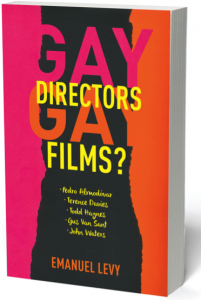
Gay Directors, Gay Films? By Emanuel Levy (Columbia University Press).
In 1934, fearing government censorship, American studios began enforcing a strict production code (drafted in 1930) that essentially outlawed the depiction of moral wrongs and ambiguities — any crime had to have consequence, overt sex was out of the question, dialogue had to be squeaky clean, and queers weren’t supposed to exist.
Regardless, some coded characters and certain gay stereotypes made it into the movies, even under censorship. Of course, the characters were not out, open, or doing anything about it, but it was clear to knowing eyes what exactly was going on.
One specific stereotype was the “pansy” — known as the “sissy” — which TCN is highlighting with films that showcase variations on this kind of character,
“The pansy craze really exploded in the 1930s,” Karger explained. “It started in live entertainment, where there were bars in Hollywood that stars and studio executives would frequent, and there were well known drag performers who were very popular amongst the Hollywood set. What you also saw in varying degrees before and after the production code was enforced, were queer coded, open, outwardly gay characters in some films.”

“The thing about the sissy is that you’re not saying this guy wants to have sex with dudes,” Durlade said. “You’re saying, ‘Oh, look at this frilly little whatever.’ That character goes all the way back to the earliest cinema. That character goes back probably to vaudeville. The sissy was a way to get around the censor, precisely because they were asexual, and so they didn’t have to wade into the murky things of perversion, because there was nothing sexual about the character. He was just there to be the butt of the joke.”
TCM will also showcase rarities like the pre-code “Call Her Savage” with Clara Bow, which presents the pansy in a far more overt fashion. This one wouldn’t have had to slip in under the censors’ noses, since it was released in 1932 before the code was in rigid enforcement.
Call Her Savage features one scene in a gay bar, and there are two boys wearing French maids outfits, flitting around, and singing about how they wish they were on a navy ship surrounded by hunky sailors. These two kids, almost 100 years ago, were able to be their true selves and talk about their true desires.
“There are scenes of him, sitting around a breakfast table, pumping all the other characters for the latest gossip. He steals every scene he’s in. Nothing is overtly gay. They can’t use that word in at that point. So he’s essentially. A lot of these men–asexual guy who’s more interested in the lives and going ons of everyone else than he is about pursuing a romantic life.
There’s a blatant hitman gay in The Big Combo.
There’s a disturbing Wendell Corey, whio acts possessively of his mobster roommate in Desert Fury.
Sal Mineo (real-life homo) is in love with James Dean in the 1955 Rebel Without a Cause.