Mulholland Drive: A Road to Obsession
How David Lynch’s discovery of Naomi Watts made an immediate star of the unknown Brit actor, who then contributed to one of his most iconic ad beloved movies.
By Francisco Valente MoMA
One of the greatest films of the 21st century, David Lynch’s Mulholland Drive (2001), wasn’t even going to be a feature–or even exist at all.
Initially, Lynch proposed it as a pilot episode for TV series that would have been a Twin Peaks (1990–91) spin-off It would have depicted Audrey Horne moving to Hollywood after the death of her friend, Laura Palmer, to fulfill her dream of becoming a movie star.
Twin Peaks, co-created with Mark Frost, was itself born out of another failed project: an adaptation of Anthony Summers’s Goddess: The Secret Lives of Marilyn Monroe, a biography that focuses on herfinal days.
“You could say that Laura Palmer is Marilyn Monroe, and that Mulholland Drive is about Marilyn Monroe, too. Everything is about Marilyn Monroe,” Lynch revealed in his book Room to Dream.
Donna Hayward in Twin Peaks wakes up and says, “It’s like I’m having the most beautiful dream and the most terrible nightmare, all at once.”
Betty Elms in Mulholland Drive is repeating what thousands of girls have said before: “I’d rather be known as a great actress than a movie star, but, you know, sometimes people end up being both.”

Naomi Watts dreams in Mulholland Drive
In Mulholland Drive, Betty Elms, played by the then-unknown British-born Naomi Watts, is an aspiring blonde actress who arrives in Los Angeles without a place to live. She finds temporary lodging in an apartment rented by an absent family member; the landlady, Coco, is played by Ann Miller, a vet srae known for her work in Hollywood musicals of the 1940s and 1950s.
As soon as Betty walks into a home she cannot afford, she finds an amnesiac, naked woman inside—a sensual, disturbing encounter that will make her fall in love with the way it made her feel. “It’ll be just like in the movies; we’ll pretend to be someone else,” says Betty to the glamorous brunette who has forgotten who she is.
She calls herself Rita after spotting Rita Hayworth on a Gilda (1946) poster, before embarking on a private, haunted investigation into her own identity, now intertwined with Betty’s.

Betty and Rita in Mulholland Drive
Our secret, impossible desire in the darkness of a theater, as we sit among strangers, is for the moving images to love us back.
Betty pursues what she came to Hollywood for, audition for the one great part that will change her career.; it not a coincidence that her clothes recall those Madeleine Elster in Hitchcock’s Vertigo (1958).
Gradually, she transforms her girlish naiveté into sexual confidence that convinces her older acting partner (who gropes her), that he is the unconditional focus of her desire.
And yet Betty can’t help going back to Rita and being in her company, dismissing what would have been a career-changing meeting with A-list director with whom she had locked eyes on a film set.
Betty locks eyes with the audience, too. The camera lens moves toward her and our gaze becomes hypnotized by this magnetic figure that we want to love and protect from an abusive world, only to find that our secret, impossible desire in the darkness of a theater, as we sit among strangers, is for the moving images to love us back.
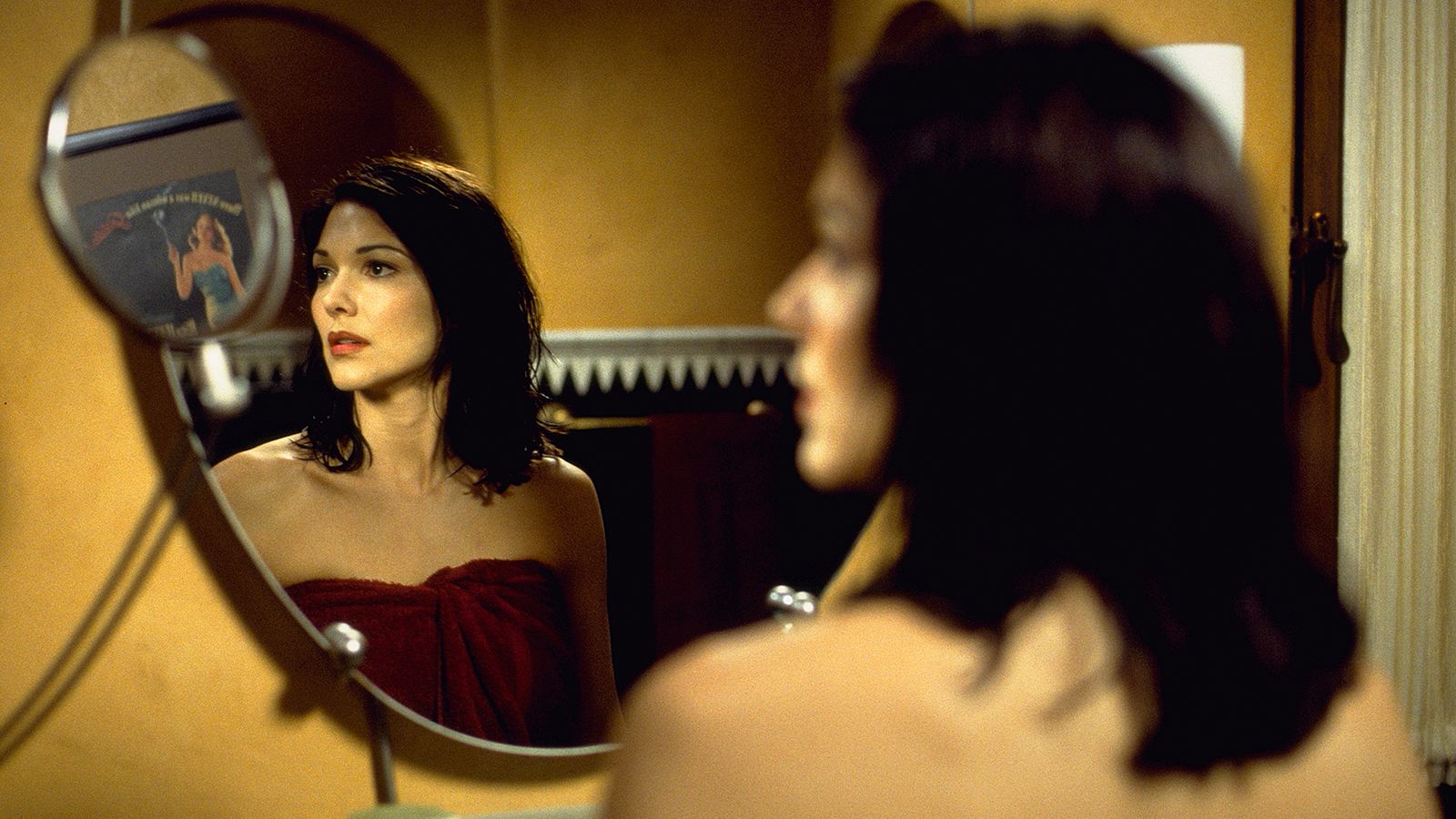
Rita in the mirror with her namesake, Rita Hayworth, in Mulholland Drive
On this long, unpaved drive, we find that unfathomable visions want a piece of us as viewers. They have a home in our morbid curiosity; they found a place to grow in Hollywood’s dream factory, looking for the beautiful and innocent to embody them before they’re thrown into eternity.
We keep returning to the darkness of theaters to believe in the greatest fantasy of all—like Betty and Rita in the film’s climax, hoping to unravel their mystery as they witness a hypnotic performance of Roy Orbinson’s “Crying.”