Merchant Ivory: Docu about Professional and Private Elements of Enduring Partnership
The prolific company founded by producer Ismail Merchant and director James Ivory became known for their acclaimed literary adaptations in the 1980s and 1990s.

It took a long time–two decades–for the films of Merchant Ivory to get critical or commercial recognition.
The production company was founded in 1961 by producer Ismail Merchant and director James Ivory, which gives Stephen Soucy’s documentary its title, .
The turning point was A Room with a View, in 1986, which became an Oscar nominated art-house crossover hit.
At their best, notably Howards End and Remains of the Day, Merchant Ivory’s films stand the test of time as elegant if stately (and at times too tasteful) period pieces.
Sam Waterston describes the principals as “pirates… charting their own course.” Others are blunter in their assessments, painting a picture of Merchant as a charming con man.
Merchant was known for beginning productions without a complete budget, cajoling money out of investors, and deferring payments for as long as possible, a practice that left cast and crew disgruntled.
Regular collaborator, Oscar winner Ruth Prawer Jhabvala, jokes in archival interview that she always expected to be visiting Ismail in prison one day.
Beavan and her co-designer John Bright also talk about shoestring nature of most Merchant Ivory projects by revealing that a costume team of just three people dressed 150 actors in Florentine crowd scene in A Room with a View.
He Could Charm the Birds Out f the Tress
Merchant’s methods were unorthodox, but he was a charming rascal whose maneuvers were impossible to resist. “He could charm the birds out of the trees,” notes Hopkins.
Ivory, in contrast, was calm and composed, with meticulous attention to detail and tendency to trust actors. Emma Thompson, who won an Oscar for Ivory’s Howards End, found the lack of cosseting on his shoots refreshing,
Merchant was a dynamic force, frequently a screamer, but always adept at finding solutions for every problem that arose.
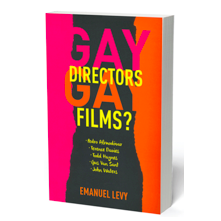
Gay Directors, Gay Films? By Emanuel Levy (Columbia University Press, August 2015)
Ivory championed their 1987 screen adaptation of E.M. Forster’s posthumously published gay novel, Maurice, overcoming Merchant’s reluctance at a time when the AIDS crisis prevailed and Margaret Thatcher’s conservative values fueling homophobia.
Ivory went one step further when he adapted screenplay for the queer classic Call Me by Your Name, which made him at 89 the oldest person to win an Oscar (tied with Ann Roth).

Novelist Jhabvala wrote 23 Merchant Ivory scripts, including their first narrative feature, The Householder, based on her book. It’s an interesting tidbit that Merchant enlisted Satyajit Ray to look at the rough cut and then step in as uncredited editor, fixing the clunky, overlong draft by repositioning the entire plot as a flashback.
Composer Robbins wrote the scores for 21 Merchant Ivory films and was romantically involved with Ismail for a time.
While the documentary’s in-depth focus is on four crucial films —A Room with a View, Maurice, Howards End and Remains of the Day, Soucy also spends some time early works like Shakespeare Wallah and on many critical disappointments (especially during the first two decades of the company).
Merchant’s unexpected death was a debilitating loss for Ivory, but it’s refreshing to see the director, now 95, lucid and planning to do more projects on his own.
Featuring: Dame Emma Thompson, Helena Bonham Carter, Hugh Grant, Vanessa Redgrave, Rupert Graves, James Wilby
Running Time: 112 min