Winfrey on Color Purple: “It’s Bright. It’s Vibrant. It’s Us”
Fantasia Barrino, Taraji P. Henson, Danielle Brooks and producer Oprah Winfrey unpack the “cinematic heirloom.”
 .
.The three female stars–Fantasia Barrino, Danielle Brooks and Taraji P. Henson speak with reverence of the original film and the book.
Henson likens it to Shakespeare for the Black community, and Brooks says, “I’ve been describing it as our cinematic heirloom. And I just really truly feel that’s what it is. It’s the thing that you cherish the most that was passed on since 1985. You take care of it and you pass it on to the next.”

Despite that reverence, Henson can see some of its flaws. “The first movie missed culturally. We don’t wallow in the muck. We don’t stay stuck in our traumas. We laugh, we sing, we go to church, we dance, we celebrate, we fight for joy, we find joy, we keep it. That’s all we have,” Henson says.
“We don’t have power. We are continuously oppressed, kept under a thumb. So what else can we do but laugh and celebrate life? We have to, otherwise we would die. So as soon as you see the first frame, you’re going to know that this movie is different. The coloring is different. It’s light, it’s bright, it’s vibrant. It’s us.”
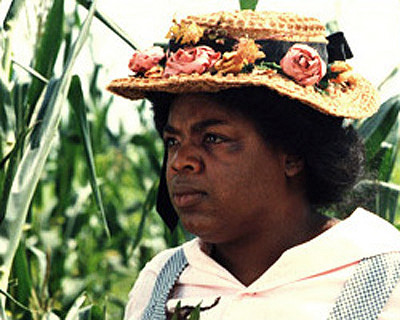
“I felt like, ‘God, why did you do this? Why did you let me get this close?’ I was running around the track at this health retreat, which they called a fat farm at the time, and praying and crying and singing ‘I Surrender All.’ And the moment that I felt like I released it, a woman comes running out and says, ‘There’s a phone call for you.’ ” It was Cannon. “He said, ‘Steven [Spielberg] wants to see you in his office tomorrow. I hear you’re at a fat farm and if you lose a pound, you lose the part.’ Wow. That’s a miracle.”
The role also led to a decades-long connection to the material. Twenty years after the original movie, producer Scott Sanders devised musical rendition for Broadway, which Winfrey was initially opposed to. She eventually became a believer, so much so that she ended up coming aboard as executive producer of the Tony-winning production and its subsequent revival. But when Sanders suggested turning it into a film, that’s where Winfrey drew the line.
“For many years, I just thought, ‘Leave it alone,’ ” she says. “Maybe it was ego, that I just felt like we’ve already done it, and I don’t think you can do it any better and now it is actually a classic. How are you going to improve on that?”
Then the #MeToo movement happened. Suddenly, Winfrey could see a new reason to bring The Color Purple to a new audience. “Sanders started saying, ‘Don’t you feel that there’s something with the energy of what’s happening to women and this movement? Maybe it’s time to go to Steven again,’ ” she recalls. “So I called up Steven and he said yes.”
Spielberg, like Winfrey, had been opposed to film adaptation of the musical adaptation of the original movie. But what Sanders was pitching, in his view, was so much more than a remake, or even what the musical had been — a version that, while hewing to the original story, reshapes its vision. “Obviously, Steven’s film lives in the culture and is a classic. No one would ever want to remake his movie,” Sanders says.
With the help of screenwriter Marcus Gardley, new vision emerged: What if the brutal abuse of Celie isn’t the core focus of the film, and instead it explores Celie’s imagination? An imagination that shows her hopes, dreams and her own agency?
That new vision was led in part by director Blitz Bazawule, who made his feature debut with The Burial of Kojo but is best known as the co-director of Beyoncé’s Black Is King, a fantastical, visually stunning retelling of The Lion King.