Gilda, made in 1946 by Charles Vidor, is an unusual film (to say the least), when placed in the broader contexts of the studio system and the typical features produced at that time, including the already “deviant” film noir.
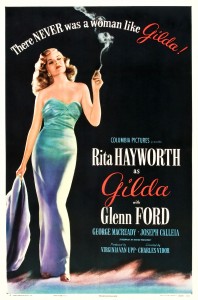
Title
The film is called Gilda, using a woman’s name, though the plot centers on a man, or rather boy/man, Johnny (Glenn Ford), a typical (generic?) Hollywood name for good/bad guys who need to change.
The plot concerns Johnny’s his radical transformation, a process that includes regaining his masculiniy, while consistently erasing Gilda’s subjectivity and independence as an agent, turning her into an objectifed image. In the last scene, she, too, must regain her status as a “normal” woman, when she suggests “let’s go home, Jhonny.”
Cinema of Excess
Throughout the film there are manifest and latent excesses in the narrative, characterization, and visual style.
Consider the following notions:
Sado-Masochism:
Johnny marries the presumably widowed Gilda in order to punish her, but in the process, he also punishes himself, as his desire for her is unwavering.
Mundson is depicted as a dead man several times–until he finally shows up at the end. It’s sort of an apocalyptic death and then resurrection.
There’s a blatantly erotic depiction of male bonding. (see my article about gay reading of the film). Johnny is more comfortable in the company of Mundson than Gilda.
Mundson as a Man
There’s no real erotic or emotion temsion between Mundson and his sexy wife Gilda. They are never seen beingb engaged in any sexual encountyer.
Moreover, Mundson is reduced to sort of a companion, oe even assistant. In two crucual scenes, he helps Gilda zip and then unzip her dress, but wenever see her naked afterwards, or, for that matter, Mundson eager to engage her sexually. They lie in bed, side by side, like social partners or companions.
Cane/Sword/Penis?
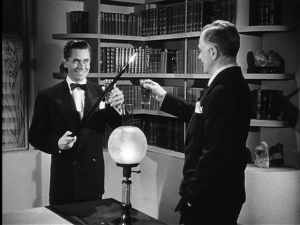
Mundson’s eroticized attachment to his cane/sword, which he calls “my little friend” (is he also describing his penis?).
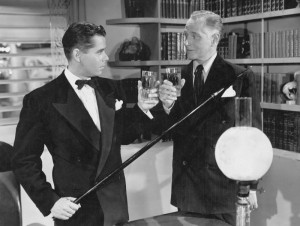
Mundson offers a toast to “the three of us,” but it’s unclear exactly who are the members of the trio. Could it be Mundson, Johnny, and his “little friend.”
At several points, the unsheathed sword is rising upward, from the waist up at a suggestive 45 degrees of erection!
Why is Johnny so often seen on the floor (first scene), seated below and beneath the other figures, who often looks down on him. Is he an inferior sort of boy/man who needs to rise up (literally) and reclaim his measure of masculinity?
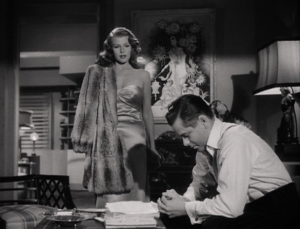
There’s also excess in the level of arousing the viewers to a spectatorship of heightened excitement. We are encouraghed to root for the characters’ already established positions of submission, wishing them to be further humiliated?
There’s excess in the opulence of the sets and costumes (especially Gilda’s), a shimmering light and expressive darkness.
See my artciles about Gilda’s tight dresses and striptease.
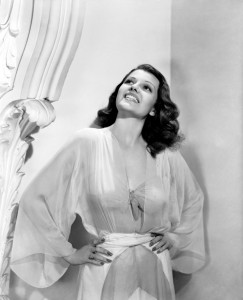
Note the intimate yet aggressive movements of the camera, and the contrived sonority of the soundtrack.
Compromised Happy Ending?
The happy ending allows Gilda to reclaim her basic, inherent goodness, and it permits Johnny to return to the mode of healthy and normal heterosexuality.
As the film is set in Argentine, the ending of “let’s go home,” reaffirms sort of patriotism in the post-WWII era. The message: There’s no place like (American) home.
The conclusion also reaffirms the viability of corporate capitalism. It suggests the restoration of justice and the authority of the law, and the wise orderliness of the middle class, which does not tolerate promiscuus women like Gilda, and boyish men like Johnny.