The Chapman Report, with Richard Zanuck as producer and George Cukor as director, was initially set to be a Twentieth Century Fox production. However, as Zanuck told me: “there was a lot of turmoil at the studio, it was the beginning of the ‘Cleopatra’ debacle. They were very disorganized, and they decided that this project was too risky and had no potential in foreign markets. We were pretty far advanced in the production, though we hadn’t started shooting yet. It took one telephone call from my father (Daryl F. Zanuck, head of Fox) to Jack Warner, who took it right away.”
Grade: C+ (** out of *****)
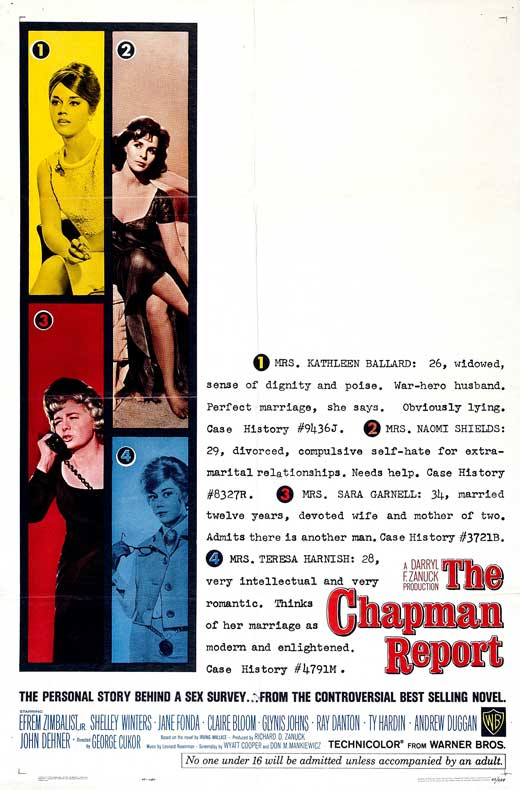
Based on Irving Wallace’s scandalous novel, The Chapman Report has an episodic structure, and sociological texture, cross-cutting among the stories of four “typical” American women. They are meant to be representative of the female gender, with the film focusing on their erotic desires (and repressions), actual sex lives, and emotional frustrations with men. (All the women are straight, of course).
A team of sexologists, not unlike the Kinsey researchers, arrive in the suburb of Brentwood in order to unearth some “startling behavioral truth” about the “respectable” married set.
By today’s standards, the film is tame and mild, but there was a great outcry about how shocking and indecent the contents of the book was upon its initial publication.
Even befire production began, The Chapman Report was touted by the studio as the “sexiest” movie ever made in America, but despite all the hype that it had received, the promised salaciousness and expected “sleazy” scenes were never there.
Censorship
The Production Code office expressed its strong concern with “the quantity of the sex episodes as well as the treatment of each incident.” Any one of the four sex episodes–a nymphomaniac, an adulterous wife, a frigid woman, a dissatisfied wife–would be sufficient material for one controversial movie, but piled into one picture, and discussed in sort of a clinical language, was unacceptable by standards of the time.
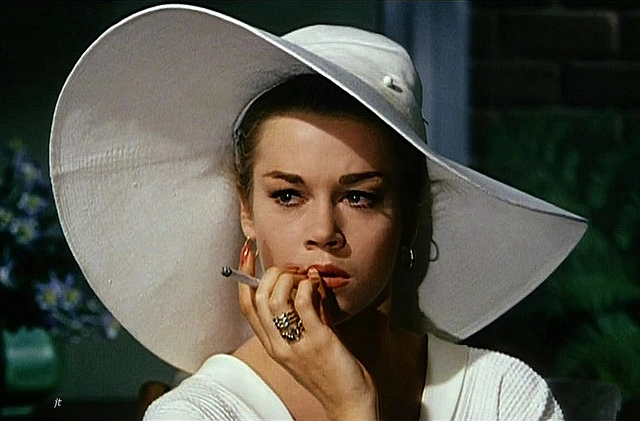
As trashy as the material was on paper, Cukor treats it with discretion and subtlety. The melodrama is considerably elevated by Cukor’s casting and tasteful direction. He cast three first-rate actresses: Claire Bloom, Shelley Winters, and Glynis Johns. The fourth actress, Jane Fonda, who was only 24 at the time, showed potential but was not established yet as a major talent.
But if the casting is near perfect, the script is not, perhas a result of too many cooks. As many as seven writers worked on the script, but in the end, Wyatt Cooper and Don Mankiewicz were officially credited for the script, and Grant Stuart and Gene Allen for adaptation. In actuality, Allen wrote the final scenario almost singlehandedly.
If Chapman Report is vaguely interesting today, it is largely for its acting, especially Claire Bloom’s daring performance. Having played many parts in the theater and on screen (“Limelioght” opposite Chaplin) Bloom’s skills are dazzling. According to Claire Bloom, “Cukor was very interested in issues of female sensitivity. I think he might have lived vicariously through certain of the tenacious feelings that my character played. He experienced the material in a different way, because he was homosexual. Like many highly tuned artists, gay or straight, he undersood instinctvely what it meant to be a man and a woman, masculine and feminine.”
The costumes are designed by a very good designer, Oscar-winner Orry Kelly. For purpose of identification, there is color coding: Every woman wears one dominant color all the way through. For example, Bloom’s color is brown and Winters’ black. This exterior gimmick makes every woman stand out, and also highlights her distinctve persona.
The Production Code officials fulfilled their “promise” to “scrutinize the finished film with minute care.” They reminded Zanuck and Cukor that one of their agreements was that the word sex would be eliminated wherever possible, to avoid giving the impression that the story was concentrating heavily on sex. But to the censors dismay, the word sex was used excessively: as much as five times on two pages. Indeed, the dialogue seemed to be too specific–the word intercourse was used in too outspoken a manner.
After a preview screening in San Francisco, where Cukor claimed the audience liked the film, the studio recut the film. At the Legion of Decency’s insistence, Jack Warner had Michael A. Hoey re-edit the film and wrote a different ending.
Cukor was both vocal and volatile about the picture’s censorship issues, particularly when Warners decided to change the ending. Cukor liked the idea that his film actually proved, rather devastatingly, that the American woman was a “kinky” item, with strong sexual desires.
However, in order to avoid an “X” rating, Warner asked for a new conclusion. In the new, revised version, Andy Dugham and Zimbalist are going over I.B.M. cards, and Dugham is made to says this horrible line: “Well, I think, by and large, the American woman’s pretty normal, wouldn’t you say?” And Zimbalist’s answer was, “Yes, completely normal,” which Cukir found both fake and morally offensive.
Warners brought in another director to reshoot the ending, with a message that was at odds with the text of Cukor’s film. A different director was brought in to reshoot it. Cukor said of Bloom: “Claire is not a nice Nellie. She has no inhibitions, and she is not as cold as some people say.”
Cukor rushed back to town from a vacation in Hawaii so that the film wouldn’t be taken away from him completely. At the end, a lot of stock film that had been shot ended up on the cutting room floor.
“What was really first-class in the film,” Cukor later said, “were these long-sustained interviews with the women who confide their sexual problems and erotic desires to the psychiatrist. The scenes were extremely well played. Jane Fonda had an emotional scene that was particularly good, but it was cut, cut, cut!”

There was a sweet sense of revenge, so to speak. Inevitably comparisons were made with other film versions of similarly trashy books by Harold Robbins or Jacqueline Susan. Not surprisinglu, most were in Cukor’s favor, probably due to his considerable tact and taste and deliberate refrain from vulgarity.
Hit by Cukor
While filming her first scene in the Chapman Report, Cukor kicked Shelley Winters in the chin. Though a “subtle kick,” it was described as an “unprovoked attack” and by Glynis Johns as “so unexpected that I did a terrible sort of double take.” On the set, tensions were high, though she and Cukor later laughed about it and he noted she was “wonderful in the picture.”