Many critics consider The Bride of Frankenstein to be the greatest of all the Frankenstein movies–and one of the best horror made by Universal.
Grade: A (***** out of *****)
| The Bride of Frankenstein | |
|---|---|
.jpg)
Theatrical release poster
|
|
The story, which follows on immediately after the events of the earlier film, is rooted in a subplot of the original and Mary Shelley novel, “Frankenstein,” published in 1818 and still admired.
Warm and cozy inside their palatial villa, Lord Byron (Gavin Gordon), Percy Shelley (Douglas Walton), and Shelley’s wife Mary (Elsa Lanchester) engage in a morbidly sparkling conversation.
The wicked Byron mockingly chastises Mary for frightening the literary world with her recent novel, “Frankenstein,” but Mary insists that her horror tale actually preached a valuable moral, that man was not meant to dabble in the works of God. Mary also adds that her story did not end with the death of Frankenstein’s monster.
Mary proceeds by telling the eagerly enthralled Byron and Shelley what had happened next. Surviving the windmill fire that ended the original 1931 tale, the Monster (Boris Karloff) quickly revives and goes on another rampage of death and destruction.
Meanwhile, his ailing creator, Henry Frankenstein (Colin Clive), discovers that his former mentor, the demented Doctor Praetorius (Ernst Thesiger), plans to create another life-sized monster, this time a woman!
After a wild “creation” sequence, the bandages are unwrapped, and the Bride of the Monster (Elsa Lanchester again) emerges. The Monster’s tender efforts to connect with his new mate are reciprocated by her revulsion and screams. “She hates me,” he growls, “Just like others!”
Wittily scripted by William Hurlbut, and expertly directed by James Whale, who stresses plot as well as mood and tone, The Bride of Frankenstein is further enhanced by the vivid Franz Waxman musical score.
The film was trimmed from 90 to 75 minutes after the first preview.
Along the way, there were sveral unpleasant encounters with the censorship board (PCA was installed a year earlier, in 1934).
Even so, The Bride of Frankenstein had the kind of vitality that few sequels have, and stands on its own merots (it’s possible to enjy iot without watching the oroginal movoe of 1931).
Since its initial release, the film’s reputation has grown, and it is now hailed as Whale’s masterpiece.
Several film scholars (myself included), recognizing Whale’s homosexuality and that of the others involved in the production, have detected latent gay sensibility in the film. Others have stressed the edgy and campy elements, both intentional and unintentional, by standards of the time.
It’s a testament to the movie’s lasting power that each generation of viewers brings its own reading of the text.
My Oscar Book:
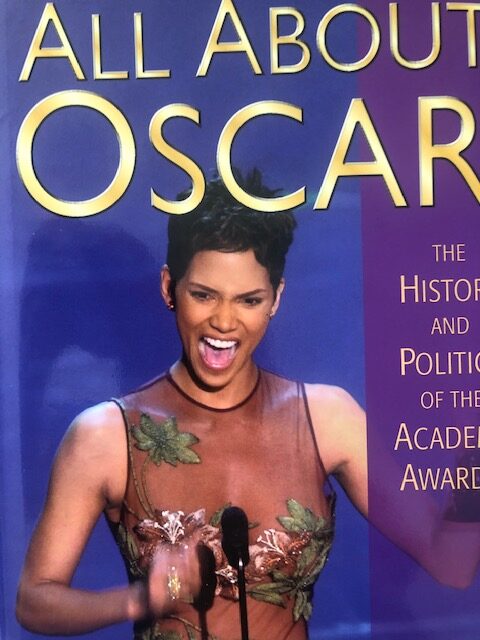
Oscar Nominations: 1
Sound Recording: Gilbert Kurland
Oscar Awards: None
The winner was Douglas Shearer (Norma’s brother) for “Naughty Marietta.”
End Note:
Director James Whale was memorably embodied by Ian McKellen in the Oscar-winning 1998 biopic Gods and Monsters.
Running time: 75 minutes
Cast
Boris Karloff as the Monster
Colin Clive as Henry Frankenstein
Valerie Hobson as Elizabeth Frankenstein
Elsa Lanchester Mary Shelley/The Bride
Ernst Thesiger Dr. Septimus Pretorius
Credits:
Directed by James Whale
Screenplay by William Hurlbut, story by Hurlbut and John L. Balderston, based on Premise suggested by Frankenstein; or, The Modern Prometheus, 1818 novel by Mary Wollstonecraft Shelley
Produced by Carl Laemmle Jr.
Cinematography John J. Mescall
Edited by Ted J. Kent
Music by Franz Waxman
Production: Universal Pictures
Distributed by Universal Pictures
Release dates: April 19, 1935 (San Francisco); April 20, 1935 (US)
Running time: 75 minutes
Budget $397,000
Box office $2 million