Blast from the Past: Revisiting Audrey Hepburn in Breakfast at Tiffany’s (1961)
As directed by Blake Edwards, in a mostly (bt not itally) savvy way, Breakfast at Tiffany’s was ahead of its zeitgeist, and it became a huge commercial success, grossing at the box-office $14 million on a $2.5 million budget.
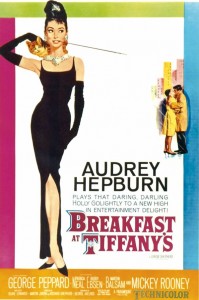
Attended by celebs, the film had received a prestige premiere at Radio City Music Hall, before its wider theatrical release.
Audrey Hepburn’s performance lights up the screen even when the text sags a bit and threatens to be too conventional and sentimental. She garnered wa idespread critical acclaim, earning her yet another Best Actress Oscar nomination; this role considered to be one of her most memorable and identifiable ones.
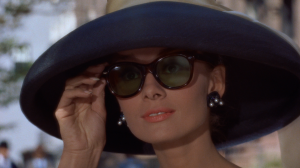
Indeed, much of the film’s iridescence comes from the richly impulsive performance by Hepburn as the scatterbrained, pathetic, fiercely independent femme.
While her character has kicked the weed, she is still the jolly Holly, a positively infantile femme who runs away only to later find some of the finer things of life.
In the wrong hands, the unconventional, disorganized, sophisticated, innocent, utterly contradictory woman could be a tiresome figure, but Hepburn makes her as sweet as she is silly, as appealing as she is affected, a playgirl without seemingly obvious scruples.
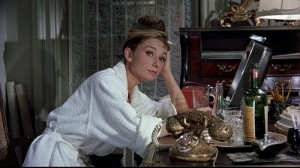
Hepburn was a genuinely charming, utterly believavle and adorable elfin waif. As Holly, her captivating flights into fancy composed of unequal dollops of comedy, romance, poignancy, funny colloquialisms and Manhattan’s swankiest sites.
Capote, who infamously disliked the film and Hepburn’s performance because they deviated from his novella, still characterized it as a “valentine to free-spirited women, not a cautionary tale about a little girl lost in the big city, it became sort of a sugar and spice confection.”
Ebsen
Ebsen appears only briefly, but to good effectm in the movie, which helped rejuvenate his career, as he later landed the role as Jed Clampett on the popular TV series, “The Beverly Hillbillies” (1962–1971).
Move’s Only Sore, Racist Note: Casting Riooney as Asian??
Mikey Rooney is offensively slapstick as the Japanese photographer, who lives ustairs delivering a performance that’s built on racist, ugly anachronisms.