Gay Sexuality in Spain Across Generations of Repression
The movie consists of three stories from distinct eras of Spanish life, dealing with the lives of three different Spanish men at various times.
In 1932, Carlos (Milo Quifes), a young man from Granada, applies for membership of the elite “Casino” club, but he is turned down due to his rumoured homosexuality.
As noted, the black ball was an elaborate ceremony, created by rigid politicians and clergymen, in which the white and black balls were solemnly rolled down a special chute.
In 1939, Sebastián is enlisted into the pro-Franco nationalist army during the civil war and falls in love with a wounded Republican prisoner-of-war that he is supposed to be guarding. This is Rafael (Miguel Bernardeau), an actor and footballer with Atlético Madrid, a handsome, vulnerable man.
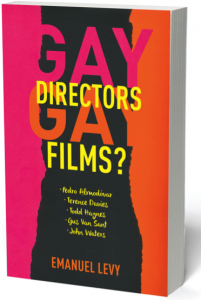
Gay Directors, Gay Films? By Emanuel Levy (Columbia University Press).
The Black Ball in 1939, as the village prepares to salute Mussolini’s fascist forces with banners and band. However, Sebastián, ignorant of politics, seems interested only in playing his trumpet.
The Italians accidentally attack the poor pro-nationalist villagers. Sebastián finds himself scrambling through the rubble of the bombed-out church, climbing across its smashed statue of Saint Sebastian, a symbol of ambiguous male sensuality.
As a member of the Francoist troops, Sebastián goes with them to see a raunchy nightclub show given by the Madrid singer Nené (a wonderful cameo from Penélope Cruz).
Confidently constructed, The Black Ball is handsomely produced, and impressively detailed.
There is also an elegant, poignant cameo of the poet Lorca, who was murdered in 1936.