In Case 137, a French Internal Affairs officer investigates police misconduct during the 2018 yellow vests protests.
Lea Drucker gives a solid performance as a dedicated public servant who’s determined to find the cops that had injured badly an innocent guy, age 20.
Director Dominik Moll’s procedural is too conventional to generate real interest, but Drucker’s performance supplies the story with its crucial emotional undercurrent.
This is Moll’s first film to screen in Cannes Film Fest Competition series since Lemming in 2005.
The Night of The 12th, his box office hit and Cesar-winning thriller, had played in Cannes Fest, in the Premiere Section.
Case 137 opens in France in November and the examination of police brutality and institutional corruption.
The film is set during the events of December 2018, when the yellow vests (gilets jaunes) protests led to violent clashes between the police and anti-tax demonstrators.
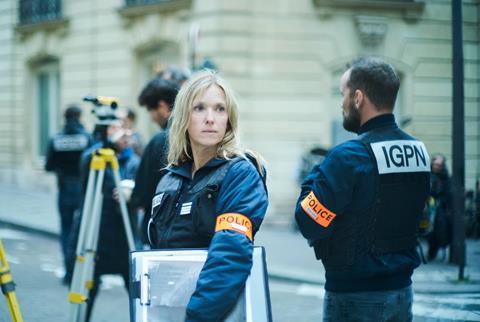
In the fictional Case 137, Stephanie (Drucker), a member of the IGPN (’the police’s police’), initiates inquiry into an attack on Guillaume (Come Peronnet), a young man who attended the protests and was shot with a riot gun by police.
Who is responsible? Why was he attacked?
Stephanie claims that it was an unprovoked attack, which tragically and imexplicably led to Guillaume suffering a fractured skull and severe brain damage.
Moll incorporates actual photos and videos of the protests into the story. That archival footage lends Case 137 verisimilitude, as does the director’s stripped-down approach to Stephanie’s investigation.
Moll gives the scenes of Stephanie questioning policemen or witnesses crisp,matter-of-fact efficiency.
What generates interest are the breaks in the case, as when she tracks down a timid maid, Alicia (Guslagie Malanda, Saint Omer), who might have witnessed Guillaume’s assault.
Stephanie’s devotion to her job is never fully explained; there are only hints of why she went from being a police officer to one investigating wrongdoing within the force; her ex-husband (Stanislas Merhar) is a hard-nosed cop.
Stephanie is a woman who believes passionately in her job, which is often thankless. In the process, she is subjected to verbal abuse from both Guillaume’s anguished family and police officers who think she’s betraying them.
Drucker makes her character’s resourceful resilience heroic, even as she occasionally stumbles, forced to grasp the hopelessness of her quest to bring the offending policemen to justice.
Case 137’s matter of fact style makes the film too generic, despite its attention to issues of racial, class and gender biases and discrimination, specifically a dissident professional middle-aged female working in (or against) a heavily aggressive and younger male police force.
It is important to note that the movie stresses that Case 137 represents just one instance (among many other potential cases) of police brutality and wrongdoing.
Credits:
Production company: Haut et Court
Producers: Caroline Benjo, Barbara Letellier, Carole Scotta
Director: Dominik Moll
Screenplay: Dominik Moll, Gilles Marchand
Cinematography: Patrick Ghiringhelli
Production design: Emmanuelle Duplay
Editing: Laurent Rouan
Music: Olivier Marguerit
Running time: 116 minutes
Cast:
Lea Drucker, Jonathan Turnbull, Mathilde Roehrich, Guslagie Malanda