Cinematographer Michael Bauman about Filming Chaos in El Paso, Interior and Exterior Shots.
He might be a burnout be-robed in tattered wear, but Bob has earned his paranoia and remembers the codes from his years as part of the French 75, a resistance cell where he met Willa’s mom, Perfidia Bevery Hills (Teyana Taylor). Getting this type of call is the one thing keeping Bob tethered to the world, Willa is in danger.
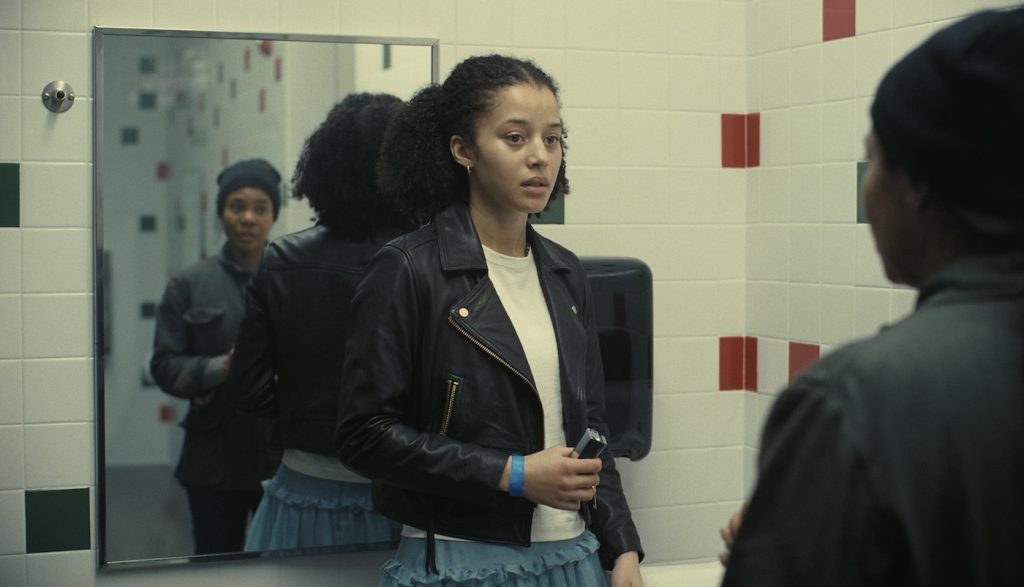
There is a breakneck sequence packed with secret tunnels, car chases, riots, firebombs, and getaways built for migrants overseen by the cool Sensei Sergio St. Carlos (Benicio Del Toro), Willa’s karate instructor, who chips in to help a supremely stressed-out Bob in his time of need.
When Bob comes into Sensei’s apartment and finds mulitple families living there, Sensei tells him that he’s running “a little Harriet Tubman situation.”
Bob then races to escape a siege on his little hamlet of Bactan Cross, orchestrated by the twisted, tweaked Col. Lockjaw (Sean Penn) and his platoon who are hunting Bob and Willa down. Bob tumbles off Sensei’s rooftop and is arrested.
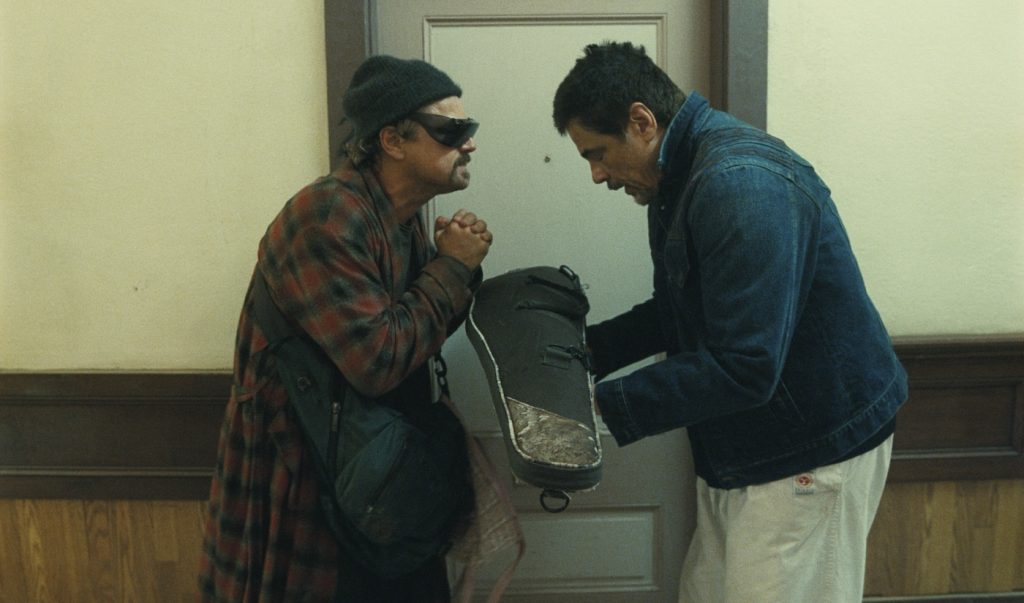
Cinematographer Michael Bauman (Licorice Pizza) shot the action in VistaVision, a format from the 1950s that produces more detailed images than the standard 35mm negative.
But even with the scope and scale, director Paul Thomas Anderson sought an indie feel. “There are all these elements because of the vehicles and chase scenes, but Paul really wanted it to be as small of footprint as possible.”
The chaotic scenes around Bob’s arrest were filmed in El Paso, Texas, a border city steeped in political history. Once a key outpost during the Mexican Revolution, it became a military hub and refuge for thousands of fleeing Mexicans, reshaping its cultural identity. Production drew inspiration from its history for the Underground Railroad storyline, with Sensei (Del Toro) operating a safe house for displaced escapees. “El Paso was accommodating as far as letting us have access to downtown, and that was critical for the car chase and creating the riot scene. The generosity of the folks there was great,” notes Bauman.
For a scene that involved Bob hiding in Sensei’s apartment, production designer Florencia Martin (Licorice Pizza, Babylon) built a complete set within a real location. “With Paul, you’re always doing practical locations. The only thing that was built on stage was when Bob crawls through the tunnel at his house and pops up at that stump,” recalls Bauman. “The whole apartment complex was the work of Florencia and Andrew Cahn, who’s our art director. They pulled some magic out of that one since we needed a space we could move through and have a bunch of different dimensionality.”
Production found a building with an abandoned upstairs close to the location that served as Sensei’s karate dojo, where Bob tries to find a phone charger. “That entire apartment, the hallway, the stairs, all the rooms in the apartment were all built,” says Bauman. “Then Anthony Carlino, who did the set decoration, sourced everything locally, and it was great, because it had so much character.”
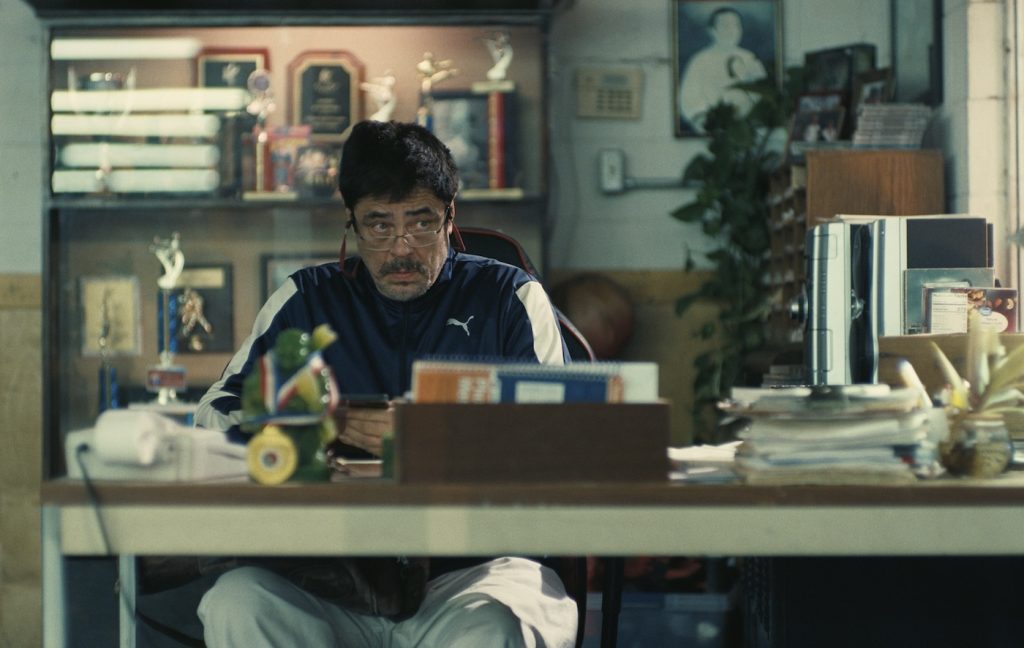 DEL TORO in “One Battle After Another.” Photo Courtesy Warner
Colors shift from fluorescent greens inside the dojo to warmer hues inside the apartment to cyan and blues as the military raids the complex. “It was a lot of naturalism. That was the whole thing on this job. Paul was like, ‘Look, nothing should look perfect. Nothing should look like a movie. It’s got to have this ‘70s vibe.’ So our star was the French Connection,” says the cinematographer.
The camera often feels restrained in the apartment, and then more paced and urgent as Bob scrambles onto the roof. “I don’t know if it was intentional, but certainly those scenes [inside the apartment] had a lot more dialogue with the two of them. I think it worked well, contrasting as soon as they stepped outside the building. It’s like Bugs Bunny and Elmer Fudd, they’re just running their asses off,” says Bauman.
The climactic road sequences were near Highway 78 in Borrego Springs, California. It’s a “sui generis chase scene capturing “a desperate but increasingly resilient young woman trying to puzzle out how to evade the psychopath behind her.” Bauman says what stood out to him was the uniqueness of the location and how much it underscores the tone of the sequence. “I don’t know how Florencia and Mike [Glaser, supervising locations manager] found it, but as soon as they found it, it was like holy sh*t, this is something.”
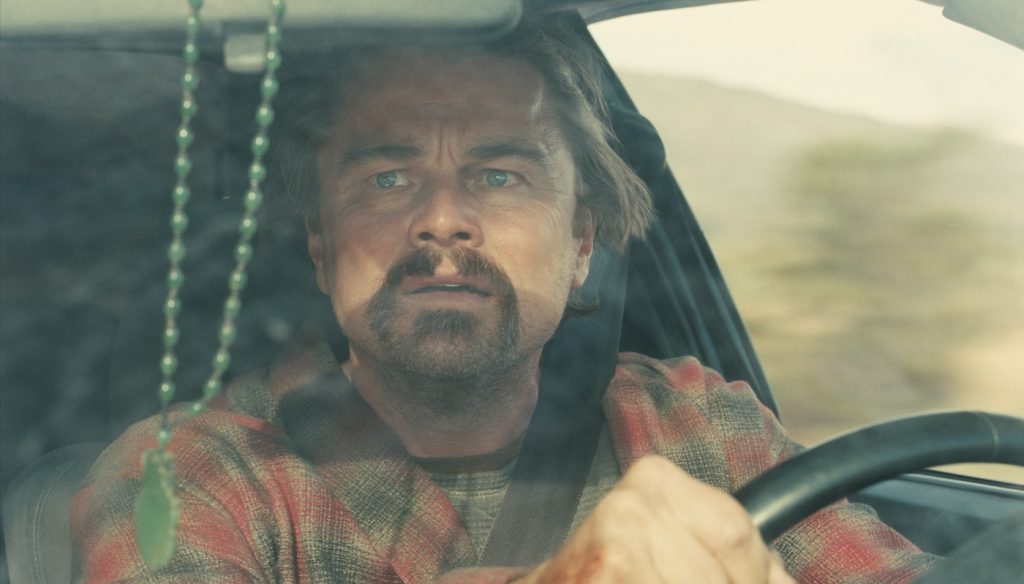
Asked how the locations in Texas and California inspired the work, Bauman says. “I got to say hats off to Florencia, she was always looking at different stuff, and Michael, who was doing locations, was looking all over the place in California. But I think it’s a lot of trying to create a tapestry of space that is in areas that people haven’t shot before. A big thing for Paul was that it was really important to stretch the muscles and find new and unique spaces.”