The Man I Love is one of Sachs most personal films. Set in the 1980s at the height of the AIDS crisis, it follows Jimmy George, a downtown performer who is dying but is desperate to take on one final role. Sachs, who’s 60, drew on his own experiences in theater and film at that time.
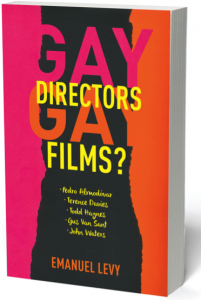
Gay Directors, Gay Films? By Emanuel Levy (Columbia University Press, August 2015).
The movie you set out to make?
There was one musical fantasy scene that didn’t make it in the film. Ultimately it became a drama with a lot of music. One of the producers said he’d never seen a film transformed throughout the process of making it the way this is. That doesn’t make sense to me, because all my films feel like that — they’re all in process until they’re completed, they sort of define themselves. The first short I made, “Lady,” was abstract. Someone asked me, “What do you want it to be?” I said, “I only know what it is when I see it complete. It reveals itself.”
Is “The Man I Love” drawn from your life?
When I started the film, I thought I was making a biography, but I ended up making an autobiography. It’s very personal.
Your surrogate? Rami’s character Jimmy or the other men?
Well, I’m still alive, so I’m not Jimmy. I could say Vincent. To an extent, the film is about survival. It’s also about memory. It comes from a place that is very much out of my experience, having known people and been connected to people and have been in love with people who had terrible illness. I had boyfriend who had AIDS, and I lived in a time in which AIDS was not just present, but it created an intense atmosphere of both dread and possibility in New York. I made a film that’s a testament to creativity as a form of survival. Art and art-making are vital to life and to breathing. In that way, I connect very much to Jimmy.
In what ways were 1980s New York time of possibility?
There was so much creativity. I arrived in the city as youthful person, so everything lay in front of me. Our intention was to make a film that was testament to the fact that one lives until the very end. One doesn’t die actively, one lives actively, and so what is life? When I first described this film, I was probably in my early 50s, and I said it’s about what do you do with the time left. This is a compressed, dramatic version of that intellectual exercise, and a specific one, because it shows the horrors of the AIDS epidemic. But there was such an artistic flourishing that came out of the East Village in the ’70s and ’80s. I’m still running on the fumes of that time. I’m so grateful to have been part of it.
Do people think enough about that era?
Historical amnesia is prevalent and not specific to gay people. It’s like that line about war — the winners are the ones you remember. The ones you hear about with AIDS are often the ones who lived. A lot of people disappeared who I knew that time in intimate way. There are fewer and fewer of us left who can tell that story.
Jimmy goes back to his hometown for parents’ anniversary party
There’s often this great divide between the person you become and the person you were; the family you create and the one you come from. If you’re in a room full of people in New York, your contemporaries, and you imagined everyone’s grandmother on their left side, and you imagine all those grandmothers around the table, what an odd assortment of people would be there. None of them would have any connection to each other. When I think of my own friends, we all were transformed by our arrival to New York. It molded us.
Casting Rami Malek
From Mr. Robot, he had this very natural, easy kind of acting in which I couldn’t see the beginnings and ends of his sentences. He’s also such a unique presence. Rami is a star, and he has something magnetic that allows him to hold a movie together.
Jimmy performs musical numbers
I’ve made movies with quite a bit of music, but I’ve never met a movie where the protagonist actually performs on that scale. What I like about the musical scenes is they become scenes of dialogue. They become conversations between Rami and the other actors, and between Jimmy and his boyfriend and his lover and his mother and his sister and his nephew. They became forms of language.
Rami Malek and Tom Sturridge are straight
I don’t ask people who they’ve slept with, and what I have found out is, you never know.
The Man I Love is your second time in Cannes?
I’m an American who has watched and digested European cinema as my precursors, mentors and educators. I’ve been very engaged with the language of European cinema and its connection to naturalism. American cinema has traditionally been rooted in theatrical transformation. M approach to finding the truth of something is more through discovering its essence than engaging in transformation.
I do read reviews, but I read them less intently as I get older. The positive reviews have the potential to affect you more deeply. The negative reviews get under your skin and make you want to fight back. John Kander of Kander & Ebb is a cousin. He was opening a show, and I sent him an email saying “break a leg.” He’s 35 years older than I am, which means he sits in a position of mentorship, and he said “the terror never leaves you.” I found it very comforting that the man who wrote “Cabaret” and “Chicago” and all these great works still gets scared, because I still get scared when I’m starting something new.
Making personal indie films?
I’m a hustler. I take money seriously, I don’t belittle money. I don’t expect a lot of money, but I work closely with my producers who understand what I need, and then they give me the range in which that will be possible. I would never go below that range, but I would never spend above it either. I had to understand that Hollywood offered me next to nothing. I had to work in different system. In 2012, I worked briefly on some studio things, but I quickly understood that it was not for me, and I was not for them.
Hollywood?
A lot of people operated in extraordinary ways under the studio system, so it’s not that great work can’t be produced in it. But if I’m going to do something, it can’t be in a corporate system. Major studios don’t make the kinds of movies that I make — non-genre driven, domestic dramas about queer people. They literally don’t make those stories. My work is inherently political.
Studio films you worked on?
I worked on a biopic about Montgomery Clift for HBO, and I worked on adaptation of a book called “Christodora” for Paramount.
Valuable experience?
No. The only thing I learned from it was what I didn’t want to do.
Political work?
I am a gay man, and I primarily make movies about gay men. Every time I make a movie, I’m overturning the idea of what is interesting to people because the dominant culture says our lives are not interesting. That’s something I refuse to accept.
We don’t have freedom of speech anymore. I’m despondent. It would be hard to look at this country and not feel shocked. Everything we held to be unchangeable and precious is disappearing. Cinema under repressive regimes adapts in ways that can be fascinating. Look at Spain during Franco or Iran under the mullahs. They kept making great art, but they did so by leaning into metaphor. That’s something queer cinema has often tried to do. But because of the times we’re living in, it seems like a good opportunity re-engage with the artists I remember from the East Village, who were always brave risk takers. No matter what, their work always felt deeply personal and very free.