Jordan Firstman Turned ‘Club Kid’ Into a Touchingly Jewish and Queer Oscar Movie
Jason Firstman, 35, does not resemble the typical filmmaker who rose to fame out of the Cannes Film Festival.
Charming impishness is what’s made his “Internet Gay” persona travel readily–manifest in his one million followers on Instagram and TikTok. Yet in May, Firstman took the French Fest by storm with Club Kid, his feature debut as a writer-director and first turn as lead man on the big screen — where the project inspired a heated bidding war.
Indie A24 beat out Focus Features, Searchlight, Netflix and Mubi for global rights deal worth $17 million, solidifying Firstman as a new force.
“It’s amazing to see the kinds of people that relate to this film, but it really is a movie about growth,” says Firstman. “In Telluride, I watched an old conservative man leave the theater in tears. Then we took it to New York Festival, which I was very nervous to do, and showed it to the 35-year-olds who do drugs. I built the story to work on many levels, with the top being a layer of warmth that feels like a hug. I explore some of my more transgressive ideas beneath the surface. If you don’t get it, there’s still a story that will make you laugh and feel.”
For some, Firstman is an overnight sensation. To others, he’s a vet comedic force for the online age. From the town of Northport on the North Shore of Long Island, Firstman moved to Manhattan like many hopeful artists had before him.
While building his social following with snark, Firstman worked in writers’ rooms for cult comedy series such as “The Other Two,” “Search Party” and “Big Mouth.”

But Firstman overcame his fears in order to shoot “Club Kid” in 26 days last year. With production budget of $5 million, Firstman sacrificed his fees as writer, director and star in exchange for two conditions: A location shoot in London, and pricey stock.
Two-time Oscar nominee and Firstman mentor Richard LaGravenese (“The Fisher King,” “Behind the Candelabra”) isn’t surprised at the debutant’s success: “What makes Jordan special is that, like any good artist, you don’t wait for invitation. You create the space for yourself in the culture. He’s done it by sticking to who he is.”
The movie also had to be decidedly gay.
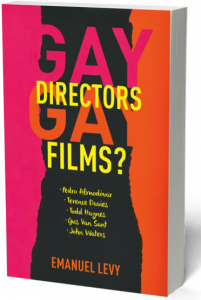
Gay Directors, Gay Films? By Emanuel Levy (Columbia University Press).
“Club Kid” sits alongside other 2026 releases that represent some of the boldest queer stories that mainstream Hollywood has produced in years: Los Javis “La Bola Negra,” Andrew Scott’s “Elsinore,” Jane Schoenbrun’s “Teenage Sex and Death at Camp Miasma” and Lukas Dhont’s fellow Cannes player “Coward.”
Queerness is integral to these movies as portraits of soldiers propping up unjust wars, artists defying heteronormative conventions to find themselves and, in Firstman’s case, a fading party boy becoming an adult.

“There hasn’t been a generation of new filmmakers since the Safdie brothers era began,” Firstman says. “Los Javis and Jane and Lukas and I are all around the same age. Our collective is so queer, people are responding, and our movies are doing well.”
“You really can’t try to steer the narrative within the gay community. But I’m speaking to them from my heart, and I feel confident in what I’m showing them. I’m also doing my best to be a good friend, and to protect my cast,” he says. “It’s been amazing seeing messages from people who say they feel seen by the movie even the judgy-ass bitches in the nightlife community. They were like, ‘You did that.’”
Josh Hutcherson, Firstman’s co-star on “I Love L.A.,” says the filmmaker is “one of the most sensitive people. He has abrasive and controversial mask, and it’s very funny. His humor shakes up the right people. But he’s also got amazing sensor for humanity.”
The movie’s sentimental value is why A24 made its big bet. Because on the other side of that LBTGQIA+ embrace is the rest of the moviegoing market, and “Club Kid” must leg out at the box office through the holiday season and beyond to reach profitability, after opening in limited release this weekend.
Firstman is personally involved in the marketing, recruiting famous DJs to spin at premiere parties in Paris, Rome, London, New York, while rolling out merchandise like “Club Kid” cropped T-shirts that resemble one his character wears in the film (“I Love Björk and Bareback,” it reads).

A24 and Firstman are betting on word-of-mouth. Conservatives could latch on to Club Kid for its depiction of a child spun into the chaos of a druggy NYC underbelly. The film’s positive response is a good indicator that audiences are receiving Firstman’s message. After all, the kid in Club Kid is often the one doing the child-rearing.
“This movie isn’t sensationalized: I don’t put a positive or negative lens on the party scene. I just try to show these people for their beauty and flaws,” says Firstman. “I wanted to explore what felt universal. A general millennial malaise. The pandemic was six years ago, and we still feel like we’re in our 20s–but we’re not. This has permeated our culture. Many friends of mine wanted to stop partying and didn’t know how.”

Firstman says he’s grateful that fame didn’t come fast or easy. Whatever fate the box office and the Oscars hold for Club Kid, he’s now leveled up as both an artist and a man.