With the meta Bitter Christmas, the Spanish auteur goes further into autofiction than ever, grappling with where to draw the line: “I really expose myself a lot.”

Bitter Christmas is Almodovar’s 24th feature over the course of 46 years.
There’s never been more than a three-year gap between his releases. He won Cannes’ best director prize in the 1990s (All About My Mother), an Oscar for best screenplay in the 2000s (Talk to Her) and the Venice Film Festival’s top prize, the Golden Lion, just two years ago (The Room Next Door). With his latest movie, Bitter Christmas, the 76-year-old Spaniard remains on that restless trajectory, pushing himself deeper into uncharted territory — this time, by turning the camera back on himself.
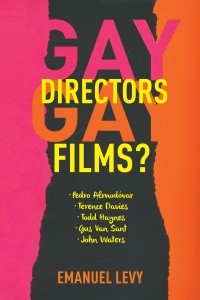
Almodovar is the subject of my book:
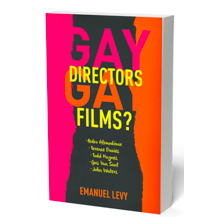
Gay Directors, Gay Films? Emanuel Levy (Columbia University Press)
The main plot follows Raúl (Leonardo Sbaraglia), a regarded filmmaker in the present day — and resembling Almodóvar — writing a screenplay inspired by period of his life from two decades earlier.
Bitter Christmas shifts between Raúl’s day-to-day, centered on his real-life bonds with assistant Mónica (Aitana Sánchez-Gijón) and boyfriend Santi (Quim Gutiérrez) seeping into his fiction, and the evolving action of Raúl’s movie (also called Bitter Christmas.
That latter arc follows director Elsa (Bárbara Lennie), who begins suffering panic attacks while feeling out her relationship with her new boyfriend, a stripper and firefighter named Bonifacio (Patrick Criado).
Raúl ruminates over how much to pull from reality in telling Elsa’s story. He is confronted by a loved one about inserting a vulnerable, private moment from their life for his own script’s ending. He considers the overlap between Santi and Bonifacio. It can feel like you’re watching an Almodóvar documentary — but of course, the director is the third layer. Raúl, too, is told through his lens.
Fans of Almodóvar can read into Bitter Christmas as much as they’d like — the lines between fact and fiction are blurry and ambiguous.
Almodóvar shares key autobiographical reference points without diving into the specifics.
My Book about Almodovar
The introspection remains fascinating, especially for a director who’s never been afraid of feelings rooted in aching truth.
The dynamic between the ailing, short-tempered Elsa and the sweet, hunky Bonifacio is drawn directly from Almodóvar’s relationship with a boyfriend from the early 2000s. The director’s long-term partner is actor-photographer Fernando Iglesias.
“Migraines had accompanied me through good chunk of my life, but the panic attacks were new to me, and this person, who I was only at the beginning of a relationship with, really saved me that first terrible weekend when it happened,” Almodóvar says.
As Elsa’s story unfurls under the command of Raúl’s typewriter, though, Bonifacio fades from that part of the narrative. There is deliberate “silence” here
As Almodóvar puts it: Is Bonifacio pining for Elsa? Frustrated with her being so preoccupied? Happy to wait for her return? The director will not say. “You don’t really know that much — like the relationship between Raúl and Santi. You don’t know whether it’s a very joyful and shared physical partnership or whether one of them is more in love than the other one. There’s not a lot of information that is shared.”
Bitter Christmas takes a bolder turn when Raúl goes too far in his exploration of autofiction. This weds the film’s two timelines with tensely electric current sourced all the way back to their creator.
Genre of self-fiction
Almodóvar had to think about how far to push this line of storytelling — and where he’d set his line for imagination to more explicitly take over. “It’s more of an ethical intuition than anything else because the genre of self-fiction doesn’t really set any limits?” he says. “The line for me is that I don’t want to harm the people that I use for inspiration. So far, I think I have succeeded. But when you’re dealing with reality and fiction, it’s always an ambiguous line — the limits are very porous.”
Almodóvar speaks frankly about how hard it can be for any subject, however loosely defined or camouflaged by remixed characteristics, to stay out of an artist’s way.
“When an author is writing about the reality that is proximate to them, you have to think that writers are always going to be selfish,” Almodóvar says. “Once they have an idea for a story, they’re not necessarily going to think about who they are going to harm or not. Once you have that story, that inspiration, it’s quite powerful and valuable — as a writer, you don’t let it go.”
So far, Almodóvar has been pleased to see audiences take the movie on its quirky terms.
Meta-storytelling is in the air: We happen to be talking on the publication day for Life of M, Rachel Cusk’s novel widely alleged to center on a thinly veiled version of Natalie Portman. The reality is more complicated–Cusk has declined to comment on the rumors at all — but the media frenzy has already dominated the narrative. “This is one example in which using inspiration perhaps did some harm,” Almodóvar says, eager to learn about Cusk’s book. “It’s a danger of self-fiction — that it then just becomes gossip.”
Almodóvar’s goal was to look inward — to offer a rare window into how and why he does what he does. And maybe negotiate, in real time and for all to see, his dramaturgical boundaries.
The script is my focus
Bitter Christmas reveals Almodóvar’s profound love for making movies and why he’s not stopping anytime soon. “I’m invested in the force of the story, making sure the story works, that it interests people — the script is my focus,” he says. No matter the degree to which a movie like this becomes an exercise in veiled memoir, “It’s never with any kind of thought about my well-being. For me, the very fact of making films is the psychological support.”
You lose the fear of exposing your intimacy