The Odyssey: Nolan’s China Interview Goes Viral–Views on Storytelling, Modern Criticism, Christian Themes
The Oscar-winning filmmaker’s substantive intervew with Chinese podcaster Zhong Shu wasn’t the usual press interview.

Oscar winner Chris Nolan (“Oppenheimer”) gave interview in China that got philosophical about art, history, storytelling, film criticism, Christian conceptions of atonement.
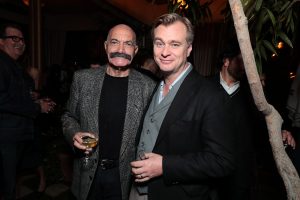
Speaking to Chinese podcaster and political philosophy lecturer Zhong Shu in Beijing, the British filmmaker gave unusual interview, no games, no soft or rushed questions about favorite moments from the production or anecdotes about actors,
Instead, the filmmaker share his personal philosophy and worldview and how that informed the making of The Odyssey
The interview has gone viral as it offered fascinating insight into the thinking of the popular filmmaker at the peak of his powers.
Bard of a civilization at dusk
Nolan as a bard of the modern age, like Homer was bard of Ancient Greece– poem as a celebration of war and victory, whereas Nolan’s adaptation of The Odyssey is the oppposite, reflecting more the current day.

“Those themes are something that from a modern perspective is frightening and interesting. For me, it partly comes out od making Oppenheimer before this, which is very much a film about the end of the world, about the collapse of civilization. I carried that sensibility into this adaptation of The Odyssey.”
Atonement doesn’t exist in Ancient Greek culture, or language, or in Homer’s poem. Nolan Christianized atonement was important in the film.
“I wasn’t too conscious of how I was approaching it philosophically other than I honed in on the idea of what’s termed ‘xenia. In the film we call it Zeus’s Law for simplicity, but it’s that idea of mutual respect–I treat you the way I want to be treated. In their theology it’s because you might be god in disguise. I drilled down on that, and I realized that for me what’s interesting about the interaction of history and mythology is the idea of ‘sea peoples’, people from the sea who were thought to have precipitated the Bronze Age collapse.
It’s one of great mysteries of history: who were they? But the idea that really a violation of xenia, a violation of Zeus’ Law — which is what the suitors are doing in the palace — that is the breaking of Zeus’ Law that is causing this difficulty and this damage.
“The idea of atonement is what we bring as viewers to the story. I don’t know whether there really is atonement in the film, or whether we just feel catharsis or that’s the process we’re seeing in the final meeting between Odysseus and Penelope. We may be bringing our more modern sensibility. Insofar as atonement is there, it’s not a deliberate attempt to Christianize it, but it’s an outgrowth or it’s a natural conclusion of burrowing in on this philosophical idea of what happens when you break Zeus’ Law.”
When you’re talking about storytelling, you’re in conversation with expectations of the audience. It is energy that’s brought from the audience as well as an energy that’s put forward from the story itself. When you’re characterizing somebody, and the trite version, or the criticism that is leveled at movies in general, is, ‘oh, the character has to be made sympathetic’ — so the character is manipulated or changed in different ways. That’s fundamental flaw of film criticism, or storytelling criticism, because to be able to identify the mechanism does not invalidate the mechanism.
A real problem in criticism today because people say because I can understand why the story affects me the way it is, therefore, it didn’t work. That’s not how storytelling works. When we create heroic figure in a story, we have to be mindful of the energy that the audience brings to that story and the interaction between our intention and the way the audience receives that. The fact that mechanism is identifiable to people doesn’t invalidate it. Part of that mechanism is saying, ‘are we going to treat greatness as absolute or coming from a democratic or… more idealized philosophical state, in today’s world, where we want to view people as equal. Do we have to apologize for greatness? The answer is yes, we do, or the audience rejects the greatness, and that is part of the mechanism. The fact that the mechanism is identifiable doesn’t mean that it’s invalid or shouldn’t be used.”
Modern “amateur” film criticism
“I was talking more about amateur than professional film criticism, because professional criticism tends to understand the necessity for the mechanisms. You’re looking at lingua frana of storytelling created by Hollywood for the last 100 years that is effectively universal and so it is its own language, and that language is understood by people all over the world, which is what’s incredible about it. It is a very accessible modern language of storytelling and it has certain rules. It has conventions, you can break conventions, you can bend them. You can move them, but you have to be aware of them the whole time.
“So when a trope becomes too familiar to an audience, then it has to be changed. But we do, as filmmakers, avail ourselves of that common language. We build on that understanding that our audience has seen many films. And that they understand that language. So, you’re playing with that language. It’s the language of genre. It’s the language of audience sympathy. It’s the language of clarity and of narrative direction and how you guide people through a story.”
So the structure of the film as it’s received by the audience is very conventional. But the chronology is unconventional. Those are the choices you make. That’s one example where you say, I need this to be familiar underneath so that I can change what’s on the surface.’ It’s a continual mechanism that’s evolving.”