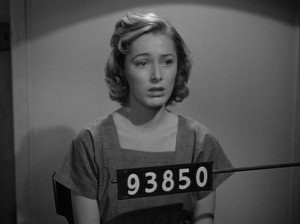
The protagonist of this stark and grim “woman’s prison melodrama” is Marie Allen (Eleanor Parker), an essentially innocent woman, age 19, who becomes an accomplice of crime.
Grade: A (***** out of *****)
Marie’s husband, in desperation, stuck up a gasoline station and was killed in the process. Not realizing what he was up to, she gets a one-to-15 year term, and bears a child in prison.
Initially, we are led to believe that through association with murderers, pickpockets and hopheads, Marie becomes herself an unregenerate outcast, though, in fact, she was just an accessory in a holdup that led to her hubby’s death.
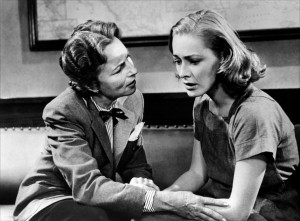
Marie enters prison as a guileless first-offender and, in the process, comes out a hard and bitter prospect for criminal career.
Along the way, she is abused by a sadistic and corrupt matron (Hope Emerson) who is later stabbed by one of her more desperate prisoners.
When Marie is finally set free, the prison superintendent (Agnes Moorehead) remarks cynically yet matter-of-factly, “Keep her file active. She’ll be back.”
Stats point out that many casual, one-time criminals often engage in crime as a career after, and as a direct result of, their brutal socialization in prison.
The prison drama genre has been male-dominated, and a lot of the press that Caged generated, had stressed the fact the novelty of seeing a harsh, often remorseless Hollywood account of a female prison.
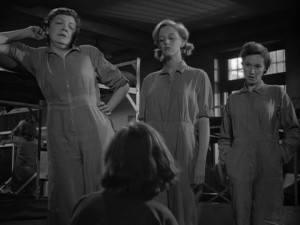
At the time, most critics simply singled out Emerson’s hardened portrait of a prison matron, but in later years, she’s been perceived as a monster, an evil personified and more of a cause than a result of life within prison walls.
A master of melodrama, John Cromwell has directed this melodrma in a taut style, coaxing excellent performance from his superlative female-dominated cast.
Alongside with Parker, Emerson, and Moorehead, the ensemble also includes Ellen Corby, Jan Sterling, Lee Patrick, and Jane Darwell.
“Caged” walks a fine line between a socially conscious drama (and wake-up call) and an exploitative featyure, ultimately emerging as an effective rather realistic expose.
John Waters and others laterparodied this subgenre in “Women Behind Bars.”
The studio had originally intended the film to be a star vehicle for Bette Davis and Joan Crawford, but financial differences intervened Davis rejected the film due to its implied lesbian content, referring to it as a “dyke movie.”
In 1950, Variety gave a mixed but predominantly positive review of Caged, characterizing it as a “grim, unrelieved study of cause and effect” that “still adds up to very drab entertainment.”
Jerry Wald’s production drew a clear picture of the dreariness of prison life and the hopelessness it instills in all but the very strong inmate. There’s high and low society, a definite blue book based on crime and convictions, among the prisoners.
The art direction, set directions and the lensing by Carl Guthrie all emphasize the grimness of prison life, and there is a Max Steiner score that fits the mood of the production.
Hollywood “Social Problem” Genre
Caged is to penal institutions what the 1948 The Snake Pit was to mental institutions and Billy Wilder’s 1944 The Lost Weekend to alcoholism. Significantly both Olivia De Havilland and Ray Milland had won best actng Oscars for their performnces.
My Oscar Book:
Oscar Nominations: 3
Actress: Eleanor Parker
Supporting Actress: Hope Emerson
Story and Screenplay: Virginia Kellogg and Bernard C. Schoenfeld
Oscar Awards: None
Oscar Context
Eleanor Parker gives one of her least mannered performances. In 1950, one of the toughest years for female leads, the Best Actress winner was Judy Holliday for Born Yesterday, beating out Bette David (“All About Eve”) and Gloria Swanson (“Sunset Boulevard”). The Supporting Actress was vet actress Josephine Hull for the comedy hit “Harvey,” starring Jimmy Stewart.
The Story and Screenplay Oscar honored Charles Brackett, Billy Wilder, and D. M. Marshman Jr. for Sunset Boulevard.